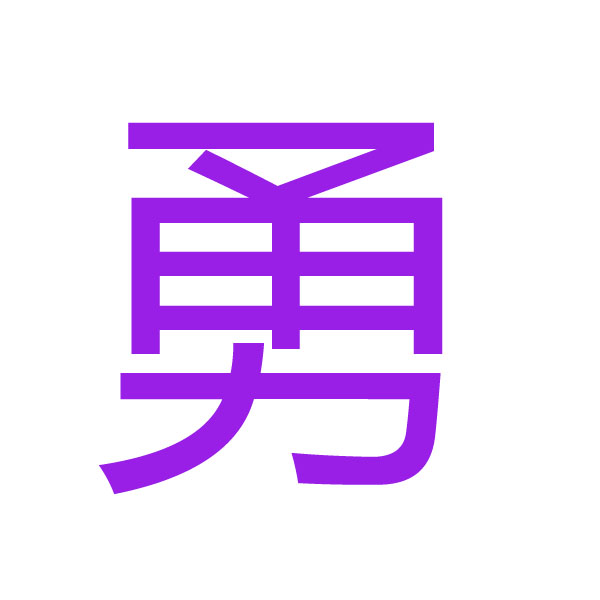
1. The Core Meaning and Usage of "勇"
The kanji 勇 carries a powerful and positive meaning related to inner strength and the ability to act in the face of fear.
A. Primary Meaning: Courage, Bravery, Valor
Reading: Yuu (ゆう) in compounds, Isamu (いさむ) as a standalone verb or name.
Meaning: The quality of mind or spirit that enables a person to face difficulty, danger, or pain without fear; bravery.
Examples:
勇気 (yuuki) = courage, bravery, nerve
勇敢 (yuukan) = brave, heroic, valiant
勇者 (yuusha) = a brave person, a hero, a champion
勇む (isamu) = to be in high spirits, to be excited, to brace oneself
B. Meaning: Military Prowess
Reading: Yuu (ゆう)
Meaning: In a more classical or formal context, it can refer to martial courage and military strength.
Examples:
武勇 (buyuu) = military prowess, valor in battle
勇猛 (yuumou) = fierce, brave, valiant
2. Correct Kanji Writing and Stroke Order
"勇" is a character of 9 strokes with a top-bottom structure. The key is to balance the top-heavy component with a strong base.
Stroke Order (9 Strokes):
Let's break it down into two main components:
The Top Part: "Male" 男 (おとこ) in a variant form (甬)
This part is derived from the character 甬 (you), which is a phonetic component. We'll write it step-by-step:
Stroke 1: A short horizontal stroke, slightly tilted upwards.
Stroke 2: A left-falling vertical stroke.
Stroke 3: A horizontal折 (oré) stroke. This is one fluid stroke: a short horizontal line that turns sharply downward into a longer vertical.
Stroke 4: A dot (丶) on the upper right.
Stroke 5: A right-falling stroke (乛) that starts from the dot and sweeps down.
Stroke 6: A short vertical stroke inside the enclosure.
The Bottom Part: "Strength" 力 (ちから)
This radical provides the core meaning of "power" or "strength."
Stroke 7: The horizontal折 (oré) stroke. This starts as a slightly curved horizontal line from left to right, then turns sharply into a long, sweeping left-falling stroke. This is the most important stroke for the character's stability.
Stroke 8: A left-falling slash that starts from the top-center and curves outwards, intersecting with the first stroke. This stroke gives the character a sense of dynamic motion and power.
Visual Guide: For a dynamic view, search "勇 stroke order" on websites like jisho.org or kakijun.jp.
Key Writing Tips:
Balance: The top part (甬) should be centered and slightly wider than the bottom part (力). The character should not look like it's tipping over.
The Power of 力: The bottom "力" (strength) must be strong and prominent. The long, sweeping final stroke of "力" (Stroke 7) should provide a solid base, as if it is physically supporting the courage from above.
Proportions: The top part should take up about two-thirds of the character's height, and the bottom "力" should take up the remaining third.
3. Historical Origin and Etymology
The history of "勇" clearly shows how its components combine to create its powerful meaning.
The Phonetic and Semantic Components:
"勇" is a classic example of a keshouji (形声字), or phono-semantic compound character, where one part suggests the sound and another suggests the meaning.Semantic Component (Meaning): 力 (chikara) - This means "strength," "power," or "effort." It is the core that defines the character's category, indicating that "勇" is a type of strength.
Phonetic Component (Sound): 甬 (yǒng) - This component is derived from an ancient word and primarily provides the pronunciation (yuu in Japanese). However, "甬" itself originally depicted a bell, and in some interpretations, it carries a connotation of "springing forth" or "bursting out."
The Conceptual Blend:
The genius of this kanji lies in the combination of these two ideas:True courage ("勇") is not just passive strength; it is the inner power that springs forth into action when faced with fear or adversity. It is proactive and dynamic.
The "strength" (力) of the heart and mind.
The "bursting forth" or "springing into action" (甬) quality of that strength.
Evolution of Meaning:
Step 1: Physical Strength and Action: In its earliest uses, "勇" referred to physical daring and the willingness to act forcefully. It was a highly valued trait in warriors.
Step 2: Moral and Inner Courage: Over time, especially under the influence of Confucian and Buddhist thought, the meaning evolved to emphasize more on moral courage—the strength to do what is right, even when it is difficult or unpopular. This is the meaning most strongly associated with words like 勇気 (courage) today.
Summary
| Aspect | Details |
|---|---|
| Kanji | 勇 |
| Meanings | Courage, Bravery, Valor: The mental or moral strength to venture, persevere, and withstand danger, fear, or difficulty. It implies action. |
| Readings | Onyomi (Chinese): YUU (ユウ) Kunyomi (Japanese): isamu (いさむ) |
| Stroke Order | 9 strokes. Top-bottom structure. Write the complex top part (甬) first, then the powerful bottom part (力). |
| Historical Journey | Phonetic "甬" (bell/spring forth) + Semantic "力" (strength) → The strength that springs forth into action → Courage, Bravery, Valor. |
In essence, "勇" is a kanji that perfectly captures the dynamic nature of courage. It is not merely the absence of fear, but the powerful, active decision to move forward despite it. Its structure tells us that courage is a force (力) that erupts into action (甬).