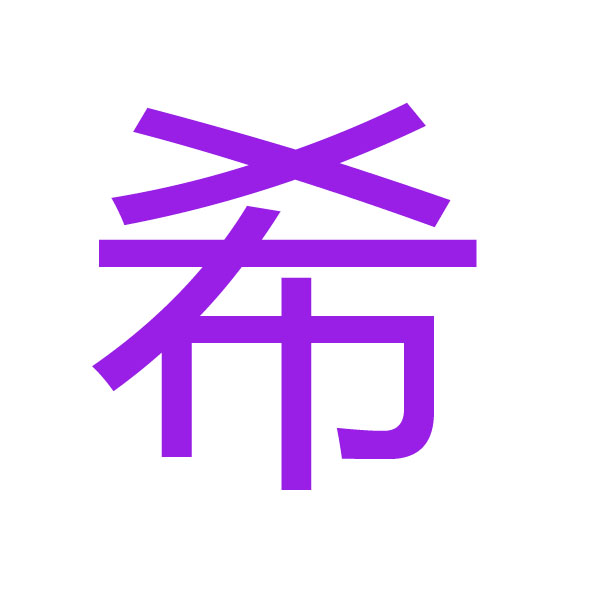
1. The Core Meaning and Usage of "希"
The kanji 希 carries a primary sense of "hope" and "wish," but it strongly overlaps with meanings of "rare," "few," and "uncommon." This duality is key to understanding it.
A. Meaning: Hope, Wish
Reading: Ki (き) or Ke (け) in compounds, often read as mare in its native Japanese form.
Meaning: To wish for something; to hope for something.
Examples:
希望 (kibou) = hope, wish, aspiration
希求 (kikyuu) = earnest desire, yearning
希う (kou) = to wish for, to request (an alternative spelling for 願う)
B. Meaning: Rare, Sparse, Uncommon
Reading: Ki (き) or Ke (け)
Meaning: This meaning emphasizes scarcity. It implies that something is so rare that you hope to see it.
Examples:
希少 (kishou) = scarce, rare, uncommon
希有 (ke'u) = rare, extraordinary, unparalleled (also written as 稀有)
希代 (kidai) = extraordinary, unheard-of (also written as 稀代)
C. As a Prefix: "Pro-"
Reading: Ki (き)
Meaning: In some scientific and academic contexts, it's used to mean "pro-" in the sense of "favoring" or "before."
Examples:
希釈 (kishaku) = dilution (lit. "rare-ing" the concentration)
希ガス (ki-gasu) = Noble Gas (lit. "Rare Gas") - This is a direct example of the "rare" meaning.
2. Correct Kanji Writing and Stroke Order
"希" is a character of 7 strokes with a clear top-bottom structure. The key is to balance the top and bottom parts.
Stroke Order (7 Strokes):
Let's break it down into two main components:
The Top Part (㐅): This is a cross-shaped pattern.
Stroke 1: A long horizontal stroke, from left to right.
Stroke 2: A long vertical stroke, cutting through the center of the horizontal stroke.
Stroke 3: A left-falling slash, from the center.
Stroke 4: A right-falling slash, from the center. (Strokes 3 and 4 form an "X" on top of the cross).
The Bottom Part (巾): This means "towel" or "cloth" and forms the base.
Stroke 5: A vertical stroke on the left side.
Stroke 6: A horizontal折 (oré) stroke. This is one fluid stroke: it starts as a horizontal line from the top of the left vertical, then turns sharply downward into a long vertical stroke that hooks slightly inward at the very end.
Stroke 7: A very short horizontal stroke inside the "巾" component, connecting to the central vertical. This is often written as a small dash.
Visual Guide: For a dynamic view, search "希 stroke order" on websites like jisho.org or kakijun.jp.
Key Writing Tips:
Balance: The top cross-and-X structure should be wide enough to comfortably "sit on" the bottom part. It should not be too small or cramped.
The Bottom (巾): The final vertical stroke (part of Stroke 6) should be the longest stroke in the entire character, providing a solid foundation.
Symmetry: Try to make the top part as symmetrical as possible. The two slashes (Strokes 3 & 4) should mirror each other.
3. Historical Origin and Etymology
The history of "希" is fascinating because its two main meanings ("hope" and "rare") are deeply intertwined.
The Original Pictograph:
The character is a combination of two elements:Top (㐅): This pattern is a stylized representation of embroidery or a woven pattern in cloth. It depicts threads crossing each other.
Bottom (巾): This is the radical for "cloth" or "towel."
The Original Meaning:
So, the original meaning of "希" was a piece of cloth with a sparse, open weave. Think of linen or gauze—fabrics where you can see through the gaps between the threads.Evolution of Meaning:
Step 1: Sparse Weave -> Rare: From the meaning of a loosely woven, see-through fabric, it naturally extended to mean "few," "sparse," "thin," and "rare." If something is see-through, the material is scarce in any given area.
Step 2: Rare -> To Hope For: This is the crucial conceptual leap. When something is rare, it becomes something you hope to see or obtain. Think of a rare bird—a "rare bird" is a "bird one hopes to see." This connection between scarcity and desire is the heart of this kanji.
Step 3: Hope -> Wish: The meaning then solidified into the general feeling of "hope" and "wish," independent of rarity.
This evolution is perfectly preserved in the two main words:
希少 (Kishou - Rare): Uses the original "sparse/scarce" meaning.
希望 (Kibou - Hope): Uses the derived "wish/desire" meaning.
Summary
| Aspect | Details |
|---|---|
| Kanji | 希 |
| Meanings | 1. Hope, Wish: A desire for something to happen. 2. Rare, Sparse, Uncommon: Something scarce or infrequent. 3. Scientific "Pro-": Used in terms like "Noble Gas" (Rare Gas). |
| Readings | Onyomi (Chinese): KI (キ), KE (ケ) Kunyomi (Japanese): mare (まれ) |
| Stroke Order | 7 strokes. Top-bottom structure. Write the cross-and-X pattern first, then the "cloth" (巾) radical underneath. |
| Historical Journey | Embroidery/Woven Pattern (㐅) + Cloth (巾) → Sparsely Woven Cloth → Thin, Sparse, Rare → To Hope For (something rare) → Hope, Wish. |
In essence, "希" is a kanji that beautifully captures a human truth: the things we hope for most are often the things that are just out of reach—the rare and precious things in life. Its very structure, a pattern on cloth, tells this ancient story of scarcity and desire.