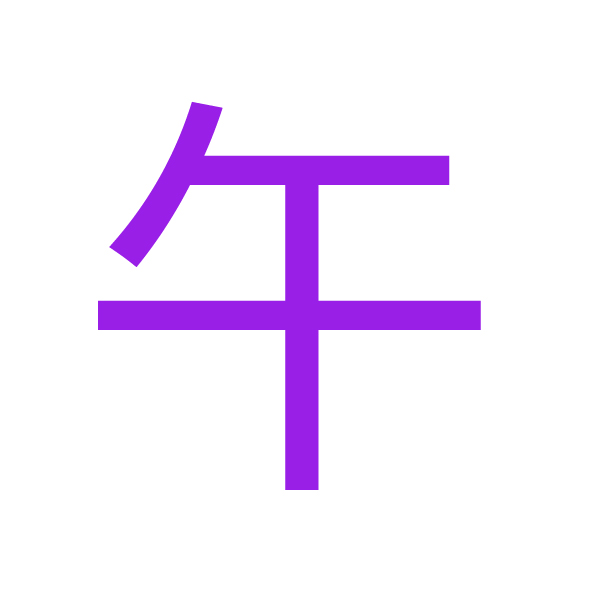
The Kanji: 午 (Uma/Go) - The "Noon" and "Horse" Kanji
The kanji "午" is a fundamental character primarily representing "noon" and is deeply connected to the Chinese zodiac sign for the Horse.
1. Meaning and Usage
Core Meanings: Noon; 11 AM-1 PM; the Horse (7th zodiac sign).
Readings:
On'yomi (Chinese reading): ゴ (go)
Kun'yomi (Japanese reading): うま (uma)
Common Words and Compounds:
午前 (ごぜん / gozen) - Morning; a.m. (Before noon)
午後 (ごご / gogo) - Afternoon; p.m. (After noon)
正午 (しょうご / shōgo) - Noon; exactly 12:00 PM
午年 (うまどし / umadoshi) - Year of the Horse
2. Writing and Stroke Order: Simple but Precise
The correct kanji writing for "午" is simple but requires precision to distinguish it from similar characters. Its stroke order is straightforward and follows basic principles.
Stroke Order:
Stroke 1: A short left-falling stroke from top to bottom.
Stroke 2: A short horizontal stroke from left to right, placed just below the first stroke.
Stroke 3: A long horizontal stroke from left to right. This is the main, defining horizontal line and should be the widest part of the character.
Stroke 4: A long, vertical stroke that starts above the top horizontal strokes, cuts through the center of the long horizontal stroke, and extends straight down. This vertical line is the central pillar of the character.
Significance of Correct Kanji Writing:
Proportions and Balance: The key to writing "午" correctly is the relationship between the horizontal strokes and the vertical stroke. The long horizontal stroke (3) must be clearly wider than the short one (2), and the vertical stroke (4) must be long and centered, providing stability. This prevents confusion with similar kanji like 牛 (cow), where the vertical stroke does not extend above the top.
Foundation for Recognition: Mastering this simple structure is crucial for correctly writing and recognizing a range of basic kanji that share similar components.
3. Historical Origin and Evolution
The history of "午" is a classic example of a character evolving from a concrete object to an abstract concept.
Oracle Bone Script (甲骨文字):
The earliest form was a clear pictogram of a pestle used for pounding grain. It depicted a wooden pestle with a thick middle part and two tapered ends. This tool was central to food preparation.
Bronze Script (金文) & Seal Script (篆書):
The form became more stylized but still retained the basic shape of a pestle. The lines became thicker and more symbolic, moving away from a direct drawing.
Modern Form (楷書):
The modern "午" is a complete abstraction. The original shape of the pestle has been simplified into the four strokes we see today. The two top strokes represent the hands or the upper part of the tool, the long horizontal represents the central, thick part, and the vertical stroke represents the shaft.
Conceptual and Cultural Connection:
The shift in meaning from "pestle" to "noon" is deeply rooted in ancient Chinese daily life and the Earthly Branches system used for tracking time.
The Pestle Connection: The pestle was a tool used with a mortar to hull rice. This labor-intensive work was often done in the middle of the day when light was best.
The Zodiac and Time: In the system of the Twelve Earthly Branches (十二支, jūnishi), "午" was assigned to the two-hour period of 11 AM to 1 PM, the very middle of the day. This period naturally became associated with "noon."
The Horse Association: The Earthly Branches were later matched with animals. "午" was paired with the Horse, an animal of energy and activity, much like the bustling energy of midday.
Summary
The kanji "午" is a character where form, history, and meaning are beautifully intertwined. It began as a drawing of a simple agricultural tool, the pestle, and through its association with the time of day when that tool was most used, it evolved into the primary symbol for "noon." Mastering its stroke order and understanding its proportions is a fundamental step in Japanese kanji writing. When you learn how to write kanji like "午," you are not just learning a character for a time of day; you are learning a symbol that connects ancient agricultural life to the modern measurement of time, all while carrying the spirited energy of the Horse from the zodiac.