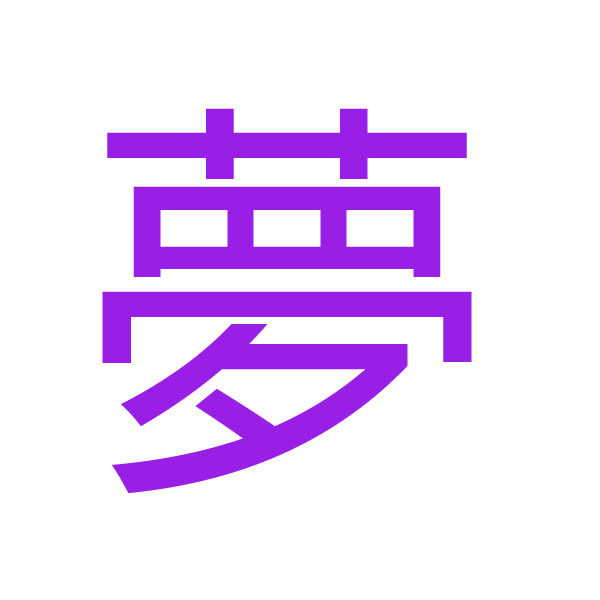
1. The Core Meaning and Usage of "夢"
The kanji 夢 primarily means "dream" – both the dreams we have while sleeping and the aspirations we hold in our waking lives.
A. Literal Meaning: A Sleeping Dream
Reading: Yume (ゆめ)
Meaning: The series of thoughts, images, and sensations occurring in a person's mind during sleep.
Examples:
夢を見る (yume o miru) = to have a dream (lit. "to see a dream")
悪夢 (akumu) = nightmare ("bad dream")
夢心地 (yumegokochi) = a dreamlike feeling, a trance-like state
B. Figurative Meaning: An Aspiration or Ideal
Reading: Yume (ゆめ) or Mu (in compounds)
Meaning: A long-cherished hope or ambition; a vision for the future.
Examples:
将来の夢 (shourai no yume) = future dream/ambition
夢を追う (yume o ou) = to pursue one's dream
夢のような話 (yume no you na hanashi) = a story that seems too good to be true (lit. "a dream-like story")
C. Philosophical/Illusory Meaning: An Illusion
Reading: Mu (む) (often in Buddhist contexts or compounds)
Meaning: Something fleeting, illusory, or unreal, emphasizing the transient nature of reality.
Examples:
夢幻 (mugen) = illusion, phantasm
夢現 (mugen) = (another reading) dream and reality; the line between illusion and truth
2. Correct Kanji Writing and Stroke Order
"夢" is a complex but beautifully balanced character. It has 13 strokes and is a top-bottom structure.
Stroke Order (13 Strokes):
It's best to break it down into three main components from top to bottom:
The Top Grass Radical (艹):
Stroke 1: A short horizontal stroke from left to right.
Stroke 2: A second short horizontal stroke below it, slightly longer.
Stroke 3: A left-falling slash.
Stroke 4: A right-falling slash. (These four strokes form the "grass" radical).
The Middle "Eye" and "Roof" (罒 → 网 & 冖):
Stroke 5: A vertical stroke down from the center.
Stroke 6: A horizontal stroke to form the left side of the "net."
Stroke 7: A vertical stroke on the right side.
Stroke 8: A small horizontal stroke inside (completing the "net/eye" component 罒).
Stroke 9: The "roof" radical (冖). This is a dot (丶) on the left, followed by a horizontal hook.
The Bottom "Evening" (夕):
Stroke 10: A short left-falling slash.
Stroke 11: A horizontal stroke that curves into a longer left-falling slash. (This forms the core of 夕).
Stroke 12: A small dot inside the 夕.
Stroke 13: The final long, sweeping horizontal stroke that acts as a "base" for the entire character. This stroke is crucial for visual stability.
Visual Guide: I highly recommend watching an animation. Search for "夢 stroke order" on sites like jisho.org or kakijun.jp.
Key Writing Tips:
Proportion: The top grass radical should be relatively small. The middle and bottom parts should be the main body of the character.
Balance: The final long horizontal stroke (Stroke 13) is essential. It should be wide enough to "carry" the entire structure above it, providing a sense of foundation.
Clarity: Ensure the middle "net" component (罒) is clearly defined and not squashed.
3. Historical Origin and Etymology
The history of "夢" is fascinating and directly reflects its meaning. Its original form was a pictograph.
Oracle Bone Script (甲骨文):
The earliest form of "夢" depicted a person lying on a bed (the 爿 component, which is a simplified bed) and using their fingers to indicate something strange happening to their eyes (the 目 component) while sleeping. Some interpretations also include a representation of a person with a large, distorted eye.The Components and Their Meaning:
The modern kanji can be deconstructed as:艹 (Grass/Plants): This is a simplification of the original "bed" (爿) component. Over time, the shape of the bed was stylized and eventually mistaken for or replaced with the grass radical.
罒 (Net/Eye): This component originally represented an eye (目). In the context of "夢," it signifies the distorted, blurry, and "caught" visions one sees during sleep, as if caught in a net.
冖 (Cover): This represents a "covering" or "roof," symbolizing the state of being asleep, covered in darkness.
夕 (Evening): This directly represents the time when dreams occur.
Evolution of Meaning:
Step 1: The Physical Act: The character originally represented the very physical act of dreaming—the phenomenon of a sleeping person experiencing visual and mental disturbances.
Step 2: The Content: The meaning then expanded to refer to the content of the dream itself—the visions and stories experienced.
Step 3: The Aspiration: Through metaphorical extension, it came to mean a waking dream or ambition—a vision for the future that one "sees" with their mind's eye.
Step 4: The Illusion: Influenced by Buddhist philosophy, which often compares the illusory nature of the material world to a dream, it also took on the meaning of illusion and fleeting reality.
Summary
| Aspect | Details |
|---|---|
| Kanji | 夢 |
| Meanings | 1. Literal: A dream during sleep. 2. Figurative: An aspiration, ambition, ideal. 3. Philosophical: An illusion, something fleeting and unreal. |
| Readings | Onyomi (Chinese): MU (ム) Kunyomi (Japanese): yume (ゆめ) |
| Stroke Order | 13 strokes. Top-to-bottom structure. Write the grass radical, then the middle "eye/net" and "roof," and finish with the "evening" and the crucial final horizontal base. |
| Historical Journey | Pictograph of a person in bed with disturbed eyes → The phenomenon of dreaming → The content of the dream → Metaphor for ambition and illusion. |
In essence, "夢" is a character that perfectly encapsulates its meaning—from its ancient form showing a person trapped in the visions of sleep to its modern use for our highest hopes and the recognition that some desires may be as fleeting as a night's dream.