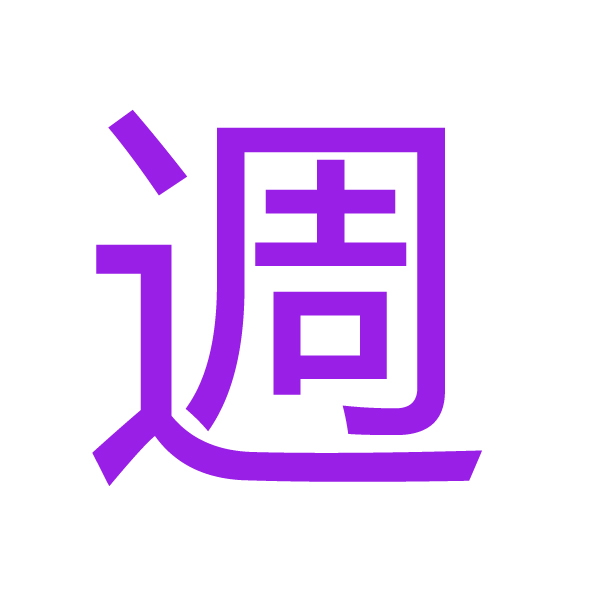
The Kanji: 週 (Shū) - The "Week" Kanji
The kanji "週" is an essential character in modern Japanese, representing the concept of a "week." It is a phono-semantic compound character, where one part suggests the meaning and the other suggests the sound.
1. Meaning and Usage
Core Meaning: Week.
Reading:
On'yomi (Chinese reading): シュウ (shū)
Common Words and Compounds:
今週 (こんしゅう / konshū) - This week
来週 (らいしゅう / raishū) - Next week
先週 (せんしゅう / senshū) - Last week
毎週 (まいしゅう / maishū) - Every week
週末 (しゅうまつ / shūmatsu) - Weekend
2. Writing and Stroke Order: An Enclosed Journey
The correct kanji writing for "週" follows the common pattern of a surrounding "movement" radical with an inner phonetic component. Mastering its stroke order is key to writing it fluidly.
Stroke Order:
"週" is composed of the 辶 (しんにょう / shinnyō) "movement" radical on the left and bottom, and the component 周 on the inside.
Inner Component (周):
Stroke 1: Left vertical stroke.
Stroke 2: Top horizontal and right vertical stroke (one continuous stroke).
Stroke 3: A vertical折 through the center.
Stroke 4: A short horizontal stroke on the left.
Stroke 5: A short horizontal stroke on the right.
Stroke 6: Bottom horizontal stroke to close the box. (Note: The inner part 周 is written before the final part of the radical).
Radical (辶 - movement/walking):
Stroke 7: The two dots at the top.
Stroke 8: The curved stroke that sweeps under the inner component.
Significance of Correct Kanji Writing:
The Enclosure Rule: A fundamental rule for kanji with the 辶 radical is to write the inner component first, then the walking radical. This ensures proper spacing and balance.
Proportions: The inner component 周 should be positioned slightly to the right, leaving comfortable space for the sweeping stroke of the radical on the left. The character should feel grounded, not cramped.
Radical Recognition: Recognizing the 辶 radical is crucial. It appears in many kanji related to movement, journey, and passage (e.g., 道 road, 通 to pass through, 運 to carry). This connection is key to the character's origin.
3. Historical Origin and Evolution
The history of "週" is a story of meaning borrowed and transformed over time.
Origin in China:
The character "週" was originally created in China. It is a phono-semantic compound (形声文字, keisei moji):
Semantic Component (辶): The "walking/movement" radical. This provided the core meaning of "to circulate," "to make a circuit," or "to go around."
Phonetic Component (周): The character 周 (shū), which means "to surround" or "circumference." This component primarily provided the pronunciation (shū), but its meaning of "surrounding" also reinforced the idea of a cycle or circuit.
Conceptual Evolution:
The original meaning was not "week" but "a full cycle" or "a revolution." It could refer to making a round of inspections or a complete circuit around an area.
Adoption in Japan and Modern Meaning:
The concept of a seven-day "week" is not native to Japan; it was imported from the West via China. When this time unit needed a written character, "週" was the perfect fit. Its core idea of "a cycle that completes and repeats" perfectly matched the cyclical nature of a seven-day week. Thus, the meaning shifted from a general "cycle" to the specific, regularly repeating cycle of a "week."
Cultural Connection:
The character "週" now embodies the modern rhythm of life. It structures our time into manageable, repeating cycles of work and rest, as seen in the all-important 週末 (weekend). It is a perfect example of how the Japanese writing system adapted an ancient character to describe a modern, imported concept.
Summary
The kanji "週" is a fascinating character whose history reflects cultural exchange and linguistic adaptation. It began as a symbol for a physical "circuit" or "cycle" and evolved into the essential unit for our modern temporal cycle—the week. Mastering its stroke order, particularly the "inner-first, radical-last" rule for the 辶 radical, is a crucial step in Japanese kanji writing. When you learn how to write kanji like "週," you are not just learning a character for "week"; you are learning a symbol that connects the ancient concept of a completed journey to the rhythm of contemporary life.