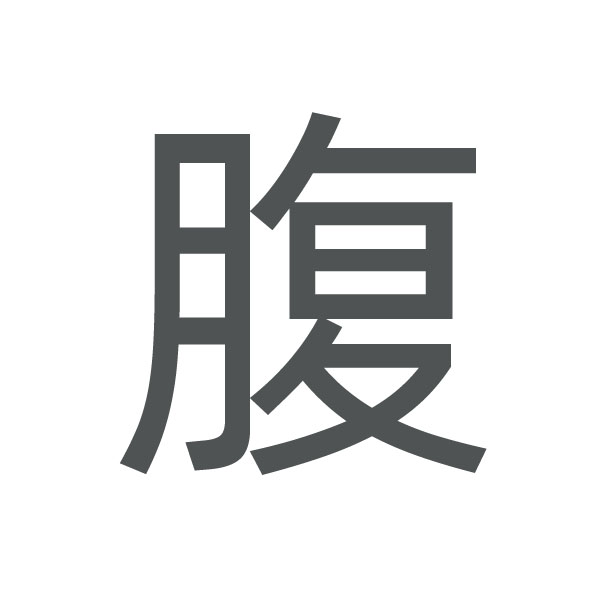
1. Kanji Breakdown: 腹
This kanji represents both a physical part of the body and the seat of emotions in Japanese culture.
Meaning: Belly, abdomen, stomach; mind, heart, feeling.
Reading:
Onyomi (Sino-Japanese reading): フク (fuku)
Kunyomi (Native Japanese reading): はら (hara)
The kanji is a phono-semantic compound (形声文字). It consists of two parts:
Left (月): This is actually the "flesh" or "body" radical (にくづき), representing the physical body.
Right (复): This component means "to return" or "repeat," and primarily provides the sound ("fuku").
The character combines the ideas of the "body" (月) and a concept related to "containing" or "holding" (from the idea of something that returns or is enclosed). Thus, it represents the part of the body that contains our organs and, by cultural extension, our inner feelings and true intentions.
2. Stroke Order and Writing
Learning the correct stroke order is crucial for balanced and beautiful kanji. "腹" has 13 strokes.
Here is the stroke order diagram and explanation:
Total Strokes: 13
Start with the left radical "月" (flesh radical):
Then, write the right part "复":
Key Writing Tips:
Write from left to right, top to bottom.
The left radical "月" is narrow.
The right part "复" is more complex. Pay attention to the correct stroke order for the top (丿) and the bottom (夂).
The overall character should feel balanced.
3. Vocabulary and Example Sentences
Here are some common words using "腹" and how to use them in sentences.
Vocabulary
腹 (はら, hara)
Meaning: Belly, abdomen, stomach.
Example: 腹が減った。
Romaji: Hara ga hetta.
English: I'm hungry. (Literally: My stomach has become empty.)
腹痛 (ふくつう, fukutsū)
Meaning: Stomach ache, abdominal pain.
Example: 昨日から腹痛がする。
Romaji: Kinō kara fukutsū ga suru.
English: I've had a stomach ache since yesterday.
腹立つ (はらだつ, haradatsu)
Meaning: To get angry, to become furious.
Example: 彼の無責任な態度に腹立った。
Romaji: Kare no musekinin na taido ni haradatta.
English: I got angry at his irresponsible attitude.
太っ腹 (ふとっぱら, futoppara)
Meaning: Big-hearted, generous, magnanimous (literally, "fat belly").
例文: 彼は本当に太っ腹な人だ。
Romaji: Kare wa hontō ni futoppara na hito da.
English: He is a truly big-hearted person.
腹を決める (はらをきめる, hara o kimeru)
Meaning: To make up one's mind, to resolve (literally, "to decide one's belly").
Example: いよいよ腹を決めた。
Romaji: Iyoiyo hara o kimeta.
English: I've finally made up my mind.
腹黒い (はらぐろい, haraguroi)
Meaning: Black-hearted, malicious, scheming.
Example: 彼は腹黒い男だ。
Romaji: Kare wa haraguroi otoko da.
English: He is a black-hearted man.
Summary
Kanji: 腹
Core Meaning: Belly, Abdomen; Mind, True Feelings.
Readings: On'yomi フク (fuku), Kun'yomi はら (hara)
Stroke Order: 13 strokes. Remember it's composed of 月 (body) and 复 (sound).
This kanji is essential for talking about both physical and emotional states. In Japanese culture, the belly (腹, hara) is traditionally seen as the seat of one's true emotions and spirit, which is why it appears in so many idioms. By mastering its stroke order and vocabulary, you will be able to correctly write and use this deeply expressive character.