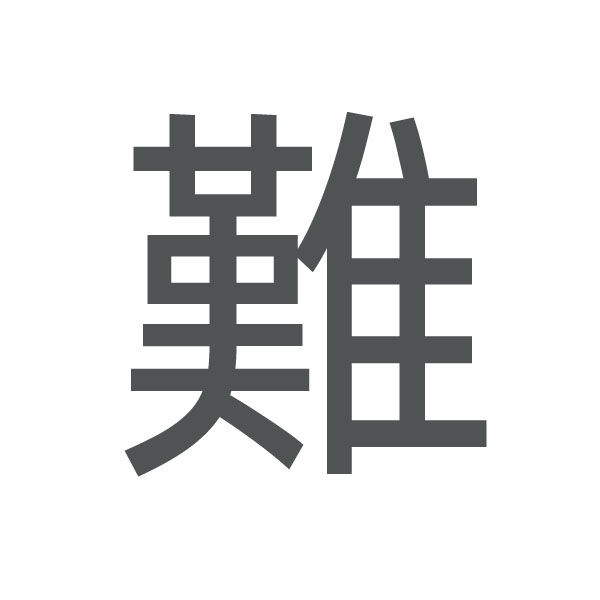
1. Kanji Breakdown: 難
This kanji represents a concept of difficulty and adversity that is fundamental to human experience.
Meaning: Difficult, hard; trouble, distress; disaster.
Reading:
Onyomi (Sino-Japanese reading): ナン (nan)
Kunyomi (Native Japanese reading): むずか(しい) (muzuka(shii)), かた(い) (kata(i))
The kanji is a phono-semantic compound (形声文字). It consists of two parts:
Left (堇): This component originally depicted a "person being burned at the stake," representing a severe trial or hardship.
Right (隹): This means "small bird."
The original and vivid meaning comes from the image of a "small bird in severe hardship or danger." A small bird is vulnerable and easily harmed, which perfectly captures the essence of difficulty, distress, and adversity.
2. Stroke Order and Writing
Learning the correct stroke order is crucial for balanced and beautiful kanji. "難" is a complex character with 18 strokes.
Here is the stroke order diagram and explanation:
Total Strokes: 18
Start with the left part "堇":
Then, write the right part "隹":
Key Writing Tips:
Write from left to right, top to bottom.
The left part "堇" is very complex. Break it down into smaller components.
The right part "隹" (small bird) should be balanced with the left side. Pay attention to the four horizontal strokes.
Due to its high stroke count, careful spacing is essential for legibility.
3. Vocabulary and Example Sentences
Here are some common words using "難" and how to use them in sentences.
Vocabulary
難しい (むずかしい, muzukashii)
Meaning: Difficult, hard.
Example: この問題は難しい。
Romaji: Kono mondai wa muzukashii.
English: This problem is difficult.
困難 (こんなん, konnan)
Meaning: Difficulty, hardship, distress.
Example: 困難に直面しても諦めない。
Romaji: Konnan ni chokumen shite mo akiramenai.
English: Even when facing difficulty, I won't give up.
災難 (さいなん, sainan)
Meaning: Disaster, calamity, misfortune.
Example: 旅行中に災難にあった。
Romaji: Ryokōchū ni sainan ni atta.
English: I met with a disaster during my trip.
非難 (ひなん, hinan)
Meaning: Criticism, blame, reproach.
例文: 彼の行動は激しく非難された。
Romaji: Kare no kōdō wa hageshiku hinan sareta.
English: His actions were severely criticized.
難民 (なんみん, nanmin)
Meaning: Refugee.
Example: 難民を支援する。
Romaji: Nanmin o shien suru.
English: To support refugees.
有難い (ありがたい, arigatai)
Meaning: Thankful, grateful (literally, "hard to exist" - something rare and precious).
Example: ご親切に有難うございます。
Romaji: Go-shinsetsu ni arigatō gozaimasu.
English: Thank you for your kindness.
Summary
Kanji: 難
Core Meaning: Difficult, Hard; Trouble, Distress.
Readings: On'yomi ナン (nan), Kun'yomi むずかしい (muzukashii)
Stroke Order: 18 strokes. Remember it's composed of 堇 (hardship) and 隹 (small bird). Practice writing it step-by-step to master its complex form.
This kanji is essential for expressing difficulty, criticism, and disaster. Interestingly, it also forms the core of the word for "thank you" (有難う), showing how gratitude arises from recognizing something is not commonplace but special. By mastering its stroke order and vocabulary, you will be able to correctly write and use this profoundly important character.