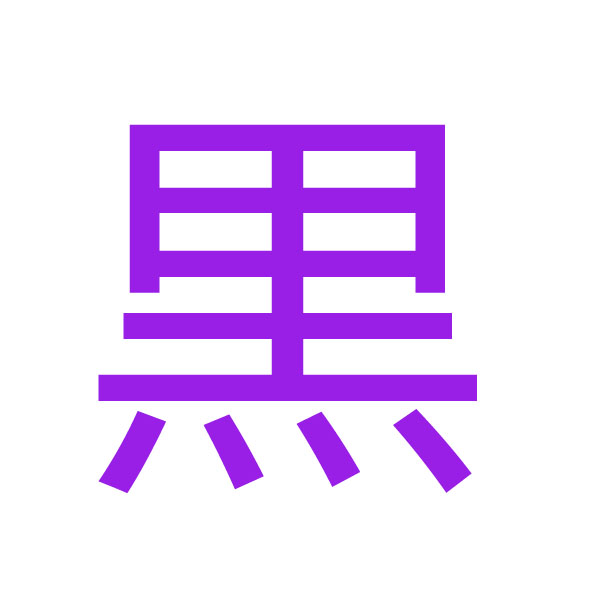
1. Kanji Breakdown: 黒
This kanji is the direct counterpart to "白" (White), representing the color black and related concepts.
Meaning: Black; dark.
Reading:
Onyomi (Sino-Japanese reading): コク (koku)
Kunyomi (Native Japanese reading): くろ (kuro), くろ(い) (kuro(i))
The kanji is a compound ideograph (会意文字). Its original form depicted a person (囚) whose face was tattooed with black ink as a punishment, with flames (炎) below, representing the soot and darkness associated with fire. The modern form can be broken down as:
Top (里?): This part is not the standard "village" (里) but a simplification of the "tattooed person" imagery.
Bottom (灬): This is the "fire" radical (れっか), representing the soot and darkness from flames.
Thus, the core idea is "the blackness of soot from fire," which evolved to mean the color black itself.
2. Stroke Order and Writing
Learning the correct stroke order is crucial for balanced and beautiful kanji. "黒" has 11 strokes.
Here is the stroke order diagram and explanation:
Total Strokes: 11
Start with the top-left vertical stroke.
The top horizontal stroke.
The left vertical stroke.
The middle horizontal stroke.
The right vertical stroke.
The bottom horizontal stroke that seals the top rectangle.
The top-left dot of the fire radical.
The top-right dot of the fire radical.
The bottom-left dot of the fire radical.
The bottom-right dot of the fire radical.
The final long horizontal stroke that forms the base of the fire radical.
Key Writing Tips:
Write from top to bottom.
The top rectangular part should be compact.
The four dots of the "fire" radical (灬) are crucial. They are not just four dots but are derived from "fire" (火). They should be evenly spaced and have a slight upward curve.
The final horizontal stroke (stroke 11) is the base and should be the longest, providing stability.
3. Vocabulary and Example Sentences
Here are some common words using "黒" and how to use them in sentences.
Vocabulary
黒い (くろい, kuroi)
Meaning: Black (adjective).
Example: 彼は黒いコートを着ている。
Romaji: Kare wa kuroi kōto o kite iru.
English: He is wearing a black coat.
黒板 (こくばん, kokuban)
Meaning: Blackboard, chalkboard.
Example: 先生が黒板に字を書いた。
Romaji: Sensei ga kokuban ni ji o kaita.
English: The teacher wrote characters on the blackboard.
暗黒 (あんこく, ankoku)
Meaning: Darkness, gloom, pitch black (both literal and metaphorical).
Example: 電気が消えて、部屋は暗黒に包まれた。
Romaji: Denki ga kiete, heya wa ankoku ni tsutsumareta.
English: The lights went out, and the room was enveloped in darkness.
黒字 (くろじ, kuroji)
Meaning: Surplus, profit (in accounting). (Literally "black characters," as opposed to 赤字 (akaji) "deficit," literally "red characters").
Example: 今月の収支は黒字だ。
Romaji: Kongetsu no shūshi wa kuroji da.
English: This month's accounts are in the black (we have a profit).
黒人 (こくじん, kokujin)
Meaning: Black person.
Example: 彼は黒人です。
Romaji: Kare wa kokujin desu.
English: He is a Black person.
Summary
Kanji: 黒
Core Meaning: Black, Dark.
Readings: On'yomi コク (koku), Kun'yomi くろい (kuroi)
Stroke Order: 11 strokes. Remember the unique structure with the top rectangle and the four-dot "fire" radical at the bottom.
This kanji, along with "白," is essential for describing colors and is used in many common words. By mastering its stroke order and vocabulary, you will be able to correctly write and use this fundamental character.