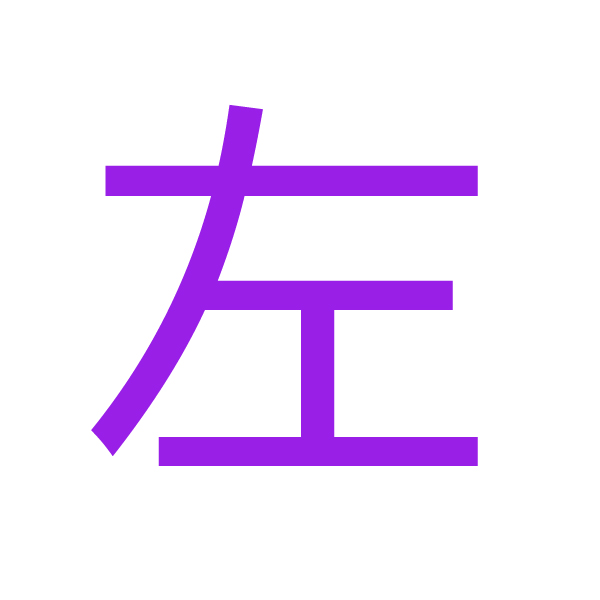
The Kanji: 左 (Hidari/Sa) - The "Left" Kanji
1. Meaning and Usage
Core Meanings: Left; left-hand side
Readings:
Kun'yomi (Japanese reading): ひだり (hidari)
On'yomi (Chinese reading): サ (sa)
Common Words and Compounds:
左 (ひだり / hidari) - Left
左右 (さゆう / sayū) - Left and right; influence
左側 (ひだりがわ / hidarigawa) - Left side
左利き (ひだりきき / hidarikiki) - Left-handed
左折 (させつ / sasetsu) - Left turn
2. Writing and Stroke Order: The Helping Hand
The correct kanji writing for "左" follows a clear structural pattern that reveals its original meaning.
Stroke Order:
Stroke 1: A long horizontal stroke from left to right
Stroke 2: A short left-falling stroke attached to the horizontal
Stroke 3: A long horizontal stroke below the first one, parallel and slightly longer
Stroke 4: A vertical折 (or) stroke that starts above, cuts through both horizontals, and ends with a hook
Significance of Correct Kanji Writing:
Proportions: The top horizontal should be shorter than the bottom horizontal
Balance: The vertical折 stroke should be centered and provide structural support
Component Recognition: Understanding that this character originally depicted a left hand helps with memorization
3. Historical Origin and Evolution
The history of "左" reveals a clear connection between physical action and directional concepts.
Oracle Bone Script (甲骨文字):
The earliest form was a pictogram of a left hand with fingers extended. The character clearly showed the thumb and fingers in a distinctive shape that distinguished it from the right hand.
Bronze Script (金文):
The form became more stylized but maintained the hand imagery. The fingers were simplified into more symbolic representations.
Seal Script (篆書):
The character evolved into a more abstract form, with the hand shape transforming into the components we recognize today. The ナ-like shape at the top represented the fingers, while the 工 at the bottom may have represented a tool or the palm.
Modern Form (楷書):
The modern "左" preserves the essential structure while standardizing the strokes for easy writing.
Original Meaning and Evolution:
Interestingly, the original meaning of "左" was "to assist" or "to help." This makes perfect sense when we consider that:
Most people are right-handed
The left hand typically plays a supporting role
The character for "right" (右) originally meant "to have" or "to possess," indicating the dominant hand
This supporting role of the left hand explains why both "左" and "右" share the same bottom component (工) - they both represent hands in action, just with different primary functions.
Cultural Significance:
In Japanese culture, "左" has several important connotations:
Traditional Hierarchy: In formal settings, the left side is often considered the position of honor
Directional System: Essential for navigation and spatial description
Political Context: In political terminology, "左翼" (sayoku) means "left wing"
Summary
The kanji "左" represents a beautiful example of how physical human experience shapes written language. Beginning as a direct pictogram of the left hand - the helping, supporting hand - it evolved into the abstract concept of "left" while preserving its structural origins. Mastering its stroke order teaches important principles of kanji composition and balance. When you learn how to write kanji like "左," you're not just learning a direction - you're connecting with ancient understanding of human anatomy and the supporting role of the non-dominant hand. This character serves as a reminder that even the most basic directional terms often have deeply practical, physical origins in daily human experience.