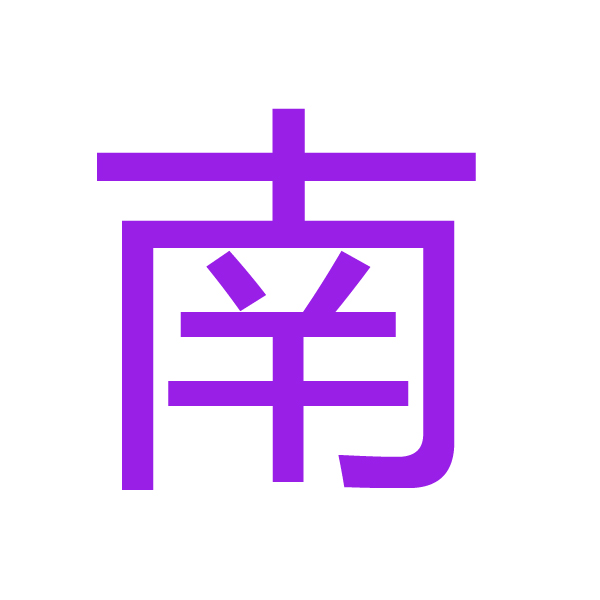
The Kanji: 南 (Minami/Nan) - The "South" Kanji
1. Meaning and Usage
Core Meanings: South; southern
Readings:
Kun'yomi (Japanese reading): みなみ (minami)
On'yomi (Chinese reading): ナン (nan)
Common Words and Compounds:
南 (みなみ / minami) - South
南米 (なんべい / Nanbei) - South America
南東 (なんとう / nantō) - Southeast
南風 (みなみかぜ / minamikaze) - South wind
南北 (なんぼく / nanboku) - North and South
2. Writing and Stroke Order: The Hanging Instrument
The correct kanji writing for "南" features a distinctive top-heavy structure with complex internal components.
Stroke Order:
Stroke 1: A right dot
Stroke 2: A short horizontal stroke
Stroke 3: A long horizontal stroke, parallel to the second
Stroke 4: A short vertical stroke on the left
Stroke 5: A short vertical stroke on the right
Stroke 6: Two short horizontal strokes inside (written left to right)
Stroke 7: A short vertical stroke through the center
Stroke 8: A left-falling stroke
Stroke 9: A right-falling stroke with hook
Significance of Correct Kanji Writing:
Structural Balance: The top portion should be wide enough to cover the bottom enclosure
Internal Organization: The internal strokes must be properly spaced and centered
Proportions: The character has a distinctive "hat" (冂) over an enclosed area
3. Historical Origin and Evolution
The history of "南" reveals an interesting musical origin that transformed into a directional concept.
Oracle Bone Script (甲骨文字):
The earliest form depicted a hanging bell or musical instrument suspended from a hook. It clearly showed:
A curved top representing the hanging hook
A bell-shaped body below
Sometimes included clappers or decorative elements
Bronze Script (金文):
The form became more stylized, with the bell shape becoming more geometric and the hanging mechanism more defined.
Seal Script (篆書):
The character evolved into a more rectangular form, with the curved bell shape transforming into the squared enclosure we see today.
Modern Form (楷書):
The modern "南" maintains the basic structure while standardizing all strokes.
Conceptual Evolution:
The connection between "bell" and "south" comes from several theories:
Musical Theory: In ancient Chinese rituals, bells were associated with southern ceremonies
Phonetic Theory: The word for "south" sounded similar to the word for this type of bell
Seasonal Theory: Bells were used in summer rituals, and south is associated with summer in Chinese cosmology
The most widely accepted explanation is phonetic borrowing - where a character was borrowed for its sound rather than its meaning.
Cultural Significance:
In Japanese culture, "南" carries important meanings:
Warmth and Growth: South is associated with warmth, sunlight, and vegetation
Regional Identity: 南日本 (Minami Nihon) refers to southern Japan's distinct climate and culture
Tropical Association: 南洋 (Nan'yō) refers to the South Seas and tropical regions
Positive Connotation: Generally carries positive associations with warmth and abundance
Summary
The kanji "南" represents a fascinating journey from musical instrument to cardinal direction. Beginning as a pictogram of a hanging bell used in ancient rituals, it was borrowed for its sound to represent the southern direction. Mastering its stroke order and complex structure teaches advanced principles of Japanese kanji writing. When you learn how to write kanji like "南," you're engaging with a character that embodies the creative and sometimes unexpected ways that written languages evolve. This character serves as a reminder that our modern directional concepts often have origins in completely different aspects of ancient life - in this case, transforming from a musical instrument into a geographical guide that continues to orient us in space and culture.