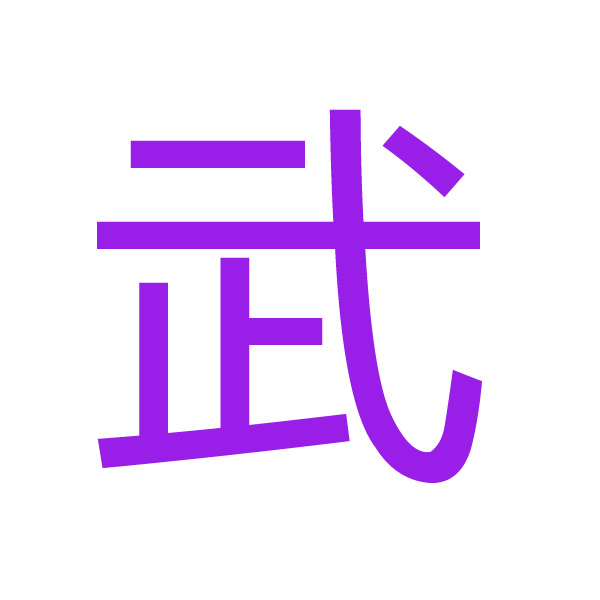
1. Meaning and Usage
The core meaning of the kanji 武 is "military," "martial," "warrior," or "valor." It represents the concept of military affairs, bravery, and the spirit of a warrior.
Common Readings and Words:
ぶ (bu): The Sino-Japanese reading used in compound words.
武士 (bushi): Samurai, warrior. (武-martial + 士-gentleman/warrior)
武道 (budō): Martial arts. (武-martial + 道-way)
武器 (buki): Weapon, arms. (武-martial + 器-tool)
武術 (bujutsu): Martial arts, military arts. (武-martial + 術-art/skill)
む (mu): A less common Sino-Japanese reading.
2. Correct Stroke Order
Writing 武 correctly is essential for balance. The kanji is composed of two main parts.
Total Strokes: 8
Step-by-Step Breakdown:
Top-left Component:
Stroke 1: Short horizontal stroke (横).
Stroke 2: Long horizontal stroke (横) below the first.
Stroke 3: Vertical stroke (竖) through the center.
Stroke 4: Short horizontal stroke (横) at the bottom.
Right Component: 弋 (Shiki - Stake)
Stroke 5: Horizontal stroke (横).
Stroke 6: Slanted hook stroke (斜鉤). This is the key stroke that gives the character its structure.
Stroke 7: Short horizontal stroke (横) on the upper part of the hook.
Stroke 8: The final dot (点) on the lower right.
Key Stroke Order Rules Applied:
Left to Right: The left part is written before the right component 弋.
Top to Bottom: This rule governs the order within the left component.
3. Historical Origins and Etymology (The "Story" Behind the Kanji)
The history of 武 is profound and is a classic example of an ideographic compound (会意文字 kaii moji). Its original meaning, however, is more nuanced than simple "warfare."
The kanji 武 is composed of two components:
戈 (Hoko): This is a pictograph of a "halberd," a long spear-like weapon. It represents weaponry or conflict.
止 (Shi): This character means "to stop." Its pictograph is a footprint, symbolizing the act of coming to a halt.
The Combined Meaning and Philosophical Significance:
The original and most celebrated meaning of 武, derived from ancient Chinese classics like the Zuo Zhuan, is:
"To stop the halberd." or "To put an end to violence."
This is a deeply philosophical concept. True 武 (martial virtue) is not about aggression or the love of fighting. Instead, it is the moral strength and bravery to use force only when necessary to bring conflict to an end and establish peace.
The "halberd (戈)" represents the tools and reality of warfare.
The "foot (止)" represents the act of halting that warfare.
Therefore, a true warrior (武士 - bushi) or someone who follows the martial way (武道 - budō) is not a mere fighter, but a person of discipline and integrity whose ultimate goal is the cessation of violence and the preservation of peace. This ethos is central to the ideal of the Japanese samurai and the philosophy behind many Japanese martial arts.
4. Example Sentences
Here are some example sentences showing the different uses of 武.
As "Samurai" (ぶ):
Romaji: Bushi wa samurai to mo yobareru.
English: Warriors are also called samurai.
武士は侍とも呼ばれる。
As "Martial Arts" (ぶ):
Romaji: Kare wa budō o keiko shite iru.
English: He practices martial arts.
彼は武道を稽古している。
As "Weapon" (ぶ):
Romaji: Sono kuni wa buki no yushutsu o kinshi shita.
English: That country banned the export of weapons.
その国は武器の輸出を禁止した。
Summary
Meaning: Military, martial, warrior, valor.
Writing: 8 strokes. Write the left part first, then the right component 弋, paying attention to the slanted hook stroke.
Origin: An ideographic compound with a profound philosophy. It combines 戈 (halberd/weaponry) with 止 (to stop) to mean "to stop the halberd." This defines true martial virtue not as aggression, but as the moral courage to use force to end violence and create peace, a concept central to the samurai ethos and Japanese martial arts.