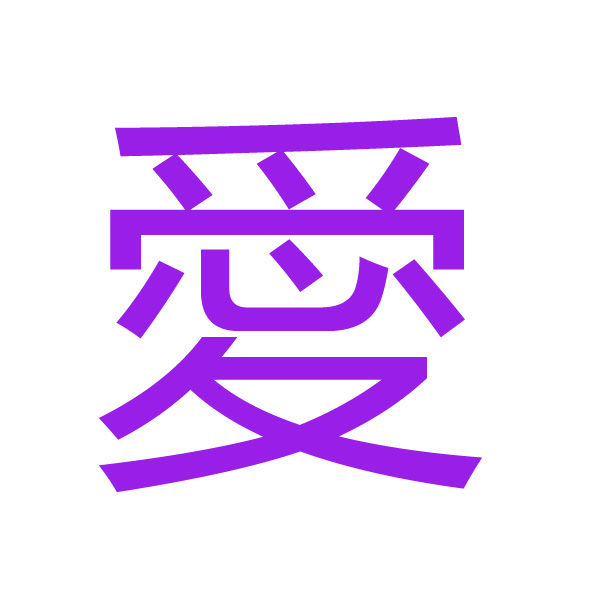
1. Meaning and Usage
The core meaning of the kanji 愛 is "love," "affection," or "to cherish." It represents a deep, caring feeling of attachment, from romantic love to compassionate love for humanity.
Common Readings and Words:
あい (ai): The Sino-Japanese reading used in compound words.
愛情 (aijō): Love, affection, deep feeling. (愛-love + 情-emotion)
愛する (aisuru): To love (the verb form).
恋人 (koibito): Lover, boyfriend/girlfriend. (恋-romantic love + 人-person)
親愛 (shin'ai): Dear, beloved. (親-parent + 愛-love)
いと (ito): Used in the adjective.
愛しい (itoishii): Beloved, dear, precious.
2. Correct Stroke Order
Writing 愛 correctly requires patience as it is a complex character with 13 strokes. Breaking it down into its four components makes the process easier.
Total Strokes: 13
Step-by-Step Breakdown:
The kanji can be broken down into four parts from top to bottom: 㤢, 冖, 夂, and 心.
Top Component: 㤢 (a variant structure)
This part is written first, following the top-to-bottom rule for the entire character.
Second Component: 冖 (Wata-kanmuri - Cover)
Stroke 1: Left dot (点).
Stroke 2: Right dot/hook (点).
Stroke 3: Horizontal stroke (横) connecting them.
Third Component: 夂 (Shi - Winter Radical)
Stroke 4: Left-falling stroke (撇).
Stroke 5: Horizontal stroke (横).
Stroke 6: Right-dot stroke (捺).
Bottom Component: 心 (Kokoro - Heart)
Stroke 7: Left dot (点).
Stroke 8: The "hook" stroke in the middle.
Stroke 9: The right dot (点).
Stroke 10: The bottom dot (点).
Key Stroke Order Rules Applied:
Top to Bottom: The entire character is written from the top down.
Left to Right: Applied within sub-components like the cover 冖.
3. Historical Origins and Etymology (The "Story" Behind the Kanji)
The history of 愛 is profound. It is an ideographic compound (会意文字 kaii moji), and its original form reveals a beautiful and nuanced meaning.
Let's break down its components in the context of its ancient form:
旡 (Ki): The top part of the original character depicted a person turning their head back, representing "attachment" or "looking back with care."
心 (Kokoro): The bottom part, which remains in the modern character, means "heart."
夂 (Shi): This component means "to follow slowly" or "to walk slowly."
The Combined Meaning:
The original character for 愛 painted this picture:
"A heart (心) that, while moving forward (夂), turns back (旡) with attachment and care."
This is a much more active and profound concept of love than a simple feeling. It implies:
Caring Action: Love is not passive; it involves looking back to ensure the well-being of the beloved.
Connection: Even while moving on your own path, your heart remains connected to another.
Reluctance to Part: The "slow walking" suggests a reluctance to leave, savoring the connection.
Over time, the character simplified into the modern 愛, but it still retains the "heart" (心) at its core, now enclosed by other elements that suggest the encompassing and protective nature of love.
4. Example Sentences
Here are some example sentences showing the different uses of 愛.
As a Noun "Love" (あい):
Romaji: Kazoku no ai wa tsuyoi.
English: Family love is strong.
家族の愛は強い。
As a Verb "To Love" (あいする):
Romaji: Watashi wa anata o ai shite imasu.
English: I love you.
私はあなたを愛しています。
As an Adjective "Beloved" (いとしい):
Romaji: Itoishii hito ni aitai.
English: I want to see my beloved person.
愛しい人に会いたい。
Summary
Meaning: Love, affection, to cherish.
Writing: 13 strokes. Write from top to bottom, breaking the character into its four main components.
Origin: An ideographic compound. Its original form depicted a "heart (心) that turns back (旡) with care while walking slowly (夂)." This powerful image defines love as an active, caring, and enduring connection rather than just a fleeting emotion. The modern form 愛 retains the "heart" at its center, symbolizing that love remains the core of this profound concept.