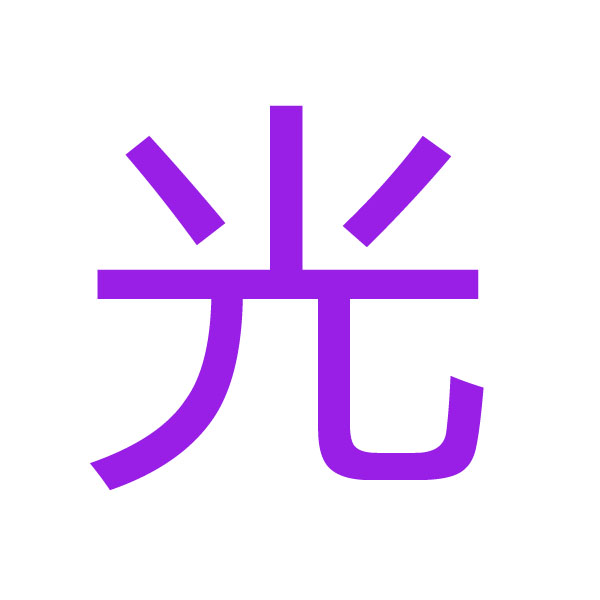
1. Kanji Breakdown: 光
This kanji represents a fundamental and beautiful natural phenomenon.
Meaning: Light, ray, gleam; to shine, to glow; honor, glory.
Reading:
Onyomi (Sino-Japanese reading): コウ (kou)
Kunyomi (Native Japanese reading): ひかり (hikari), ひか(る) (hika(ru))
The kanji is a compound ideograph (会意文字). Its original form is a pictograph of a flaming person (人), symbolizing a person with a flame above their head, representing the emission of light and brilliance. The modern form can be broken down as:
Top (⺌): A simplification of the "flame" element.
Bottom (儿): This is a variant of the "person" (人) radical.
Thus, the core imagery is of a "person emitting light," which evolved to mean light, shine, and glory.
2. Stroke Order and Writing
Learning the correct stroke order is crucial for balanced and beautiful kanji. "光" has 6 strokes.
Here is the stroke order diagram and explanation:
Total Strokes: 6
Start with the top-left dot. (A short stroke)
The top-right dot. (A short stroke)
The horizontal stroke that connects from the center.
The left-falling stroke. (A long diagonal from the center)
The right-falling stroke. (A shorter diagonal that curves slightly)
The final vertical hook. (This stroke starts vertically and ends with a hook to the upper left)
Key Writing Tips:
Write from top to bottom.
The top two dots should be balanced.
The central horizontal stroke (3) is the backbone that holds the character together.
The final stroke (6) is a distinctive vertical hook, not a simple straight line. This gives the character a dynamic and finished look.
3. Vocabulary and Example Sentences
Here are some common words using "光" and how to use them in sentences.
Vocabulary
光 (ひかり, hikari)
Meaning: Light, beam, ray (noun).
Example: 窓から光が差し込む。
Romaji: Mado kara hikari ga sashikomu.
English: Light streams in from the window.
光る (ひかる, hikaru)
Meaning: To shine, to glitter, to glow (verb).
Example: 夜空に星が光っている。
Romaji: Yozora ni hoshi ga hikatte iru.
English: Stars are shining in the night sky.
日光 (にっこう, nikkou)
Meaning: Sunlight, sunshine.
Example: 日光を浴びて気分が良くなった。
Romaji: Nikkou o abite kibun ga yoku natta.
English: I felt better after bathing in the sunlight.
光線 (こうせん, kousen)
Meaning: A ray of light, beam.
Example: レーザー光線を使った。
Romaji: Rēzā kousen o tsukatta.
English: I used a laser beam.
光栄 (こうえい, kouei)
Meaning: Honor, privilege.
Example: お会いできて光栄です。
Romaji: O-ai dekite kouei desu.
English: It's an honor to meet you.
観光 (かんこう, kankou)
Meaning: Sightseeing, tourism.
Example: 京都は観光で有名だ。
Romaji: Kyōto wa kankou de yūmei da.
English: Kyoto is famous for sightseeing.
Summary
Kanji: 光
Core Meaning: Light, Shine, Glory.
Readings: On'yomi コウ (kou), Kun'yomi ひかり (hikari)
Stroke Order: 6 strokes. Focus on the balanced top, the central horizontal stroke, and the distinctive final vertical hook.
This kanji is essential for describing light, brilliance, and honor. By mastering its elegant stroke order and vocabulary, you will be able to correctly write and use this radiant character.