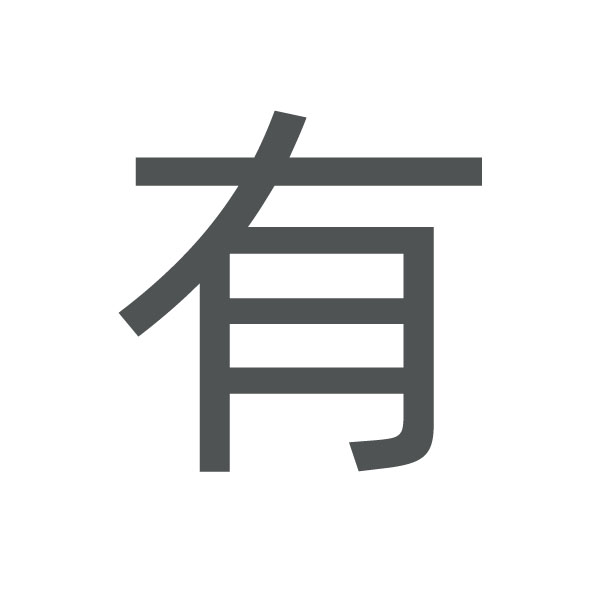
1. Kanji Breakdown: 有
This kanji represents a fundamental concept of existence and possession.
Meaning: To have, to possess, to exist; there is.
Reading:
Onyomi (Sino-Japanese reading): ユウ (yuu), ウ (u)
Kunyomi (Native Japanese reading): あ(る) (a(ru))
The kanji is a compound ideograph (会意文字). It consists of two parts:
Top (ナ): This is a simplification of the character "又" which means "hand."
Bottom (月): This means "moon" or "flesh," but in this context, it originally represented a "piece of meat."
The original and vivid meaning is "to hold meat in one's hand." In ancient times, possessing meat was a clear sign of wealth and substance. This imagery evolved into the broader meanings of "to have," "to possess," and "to exist."
2. Stroke Order and Writing
Learning the correct stroke order is crucial for balanced and beautiful kanji. "有" has 6 strokes.
Here is the stroke order diagram and explanation:
Total Strokes: 6
Start with the top horizontal stroke. (From left to right)
The left-falling stroke. (A diagonal from the top-right)
The left vertical stroke of "月". (From top to bottom)
The right vertical stroke of "月". (From top to bottom)
The middle horizontal stroke inside "月". (From left to right)
The final horizontal stroke inside "月". (From left to right)
Key Writing Tips:
Write from top to bottom.
The top part (ナ) should be slightly smaller than the bottom part (月).
The two vertical strokes of "月" should be parallel.
The overall character should be well-balanced and upright.
3. Vocabulary and Example Sentences
Here are some common words using "有" and how to use them in sentences.
Vocabulary
有る (ある, aru)
Meaning: To exist, to have (for inanimate objects).
Example: 机の上に本がある。
Romaji: Tsukue no ue ni hon ga aru.
English: There is a book on the desk.
有名 (ゆうめい, yūmei)
Meaning: Famous, well-known.
Example: 彼は有名な歌手です。
Romaji: Kare wa yūmei na kashu desu.
English: He is a famous singer.
有料 (ゆうりょう, yūryō)
Meaning: Fee-based, paid, toll.
Example: この駐車場は有料です。
Romaji: Kono chūshajō wa yūryō desu.
English: This parking lot is paid.
所有 (しょゆう, shoyū)
Meaning: Ownership, possession.
例文: この土地の所有権は私にあります。
Romaji: Kono tochi no shoyū-ken wa watashi ni arimasu.
English: I have ownership of this land.
有能 (ゆうのう, yūnō)
Meaning: Able, capable, competent.
Example: 彼は有能な社員だ。
Romaji: Kare wa yūnō na shain da.
English: He is a competent employee.
有り難う (ありがとう, arigatō)
Meaning: Thank you (Originally meaning "rare and difficult to exist," implying something precious and worthy of gratitude).
Example: ご親切に有り難うございます。
Romaji: Go-shinsetsu ni arigatō gozaimasu.
English: Thank you for your kindness.
Summary
Kanji: 有
Core Meaning: To Have, To Possess, To Exist.
Readings: On'yomi ユウ (yuu), Kun'yomi ある (aru)
Stroke Order: 6 strokes. Remember its origin from a hand holding meat, which helps visualize its structure.
This kanji is absolutely essential for basic expression in Japanese, used to indicate existence, possession, and in many common compound words. By mastering its stroke order and vocabulary, you will be able to correctly write and use this fundamental character.