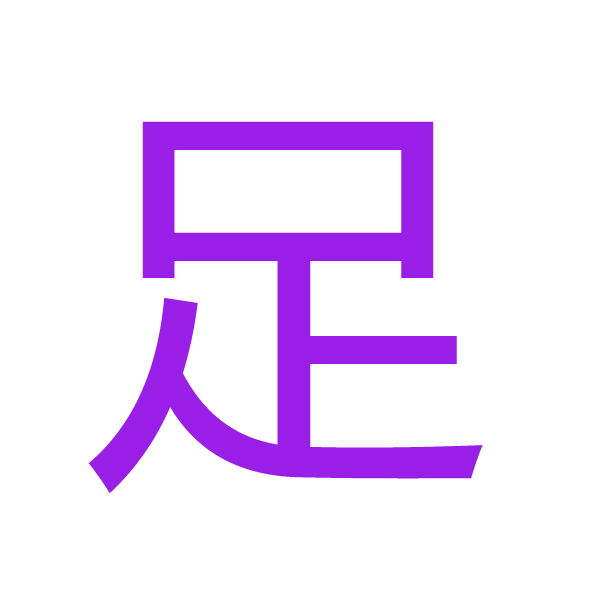
The Kanji: 足 (Ashi/Soku) - The "Foot" and "Sufficient" Kanji
The kanji "足" is a fascinating character with two primary meanings that, at first glance, seem unrelated: the physical "foot" or "leg," and the abstract concept of "sufficiency." Its history beautifully connects these ideas.
1. Meaning and Usage
Core Meanings: Foot; leg; to be sufficient; to add.
Readings:
Kun'yomi (Japanese reading): あし (ashi), た.りる (tariru), た.る (taru)
On'yomi (Chinese reading): ソク (soku)
Common Words and Compounds:
足 (あし / ashi) - Foot; leg
足音 (あしおと / ashioto) - Footstep
満足 (まんぞく / manzoku) - Satisfaction (Literally "full-sufficient")
不足 (ふそく / fusoku) - Insufficiency; shortage
足りる (た.りる / tariru) - To be sufficient; to be enough
2. Writing and Stroke Order: A Stable Foundation
The correct kanji writing for "足" is essential. Its stroke order builds from the top down, creating a stable character that visually resembles a person standing on a foot.
Stroke Order:
Stroke 1: A short left-falling stroke.
Stroke 2: A short horizontal stroke, placed just below the first.
Stroke 3: A long horizontal stroke, parallel to and below the second stroke. This is the main "shoulder" of the character.
Stroke 4: A vertical折 through the center of the horizontals.
Stroke 5: A short horizontal stroke attached to the vertical.
Stroke 6: A left-falling stroke from the vertical.
Stroke 7: A right-falling stroke from the vertical, forming a stable base.
Significance of Correct Kanji Writing:
Balance and Stability: The character should have a wide, stable base (the final two strokes) that can support the top part. This structure visually mimics a foot supporting a body.
Proportions: The top part (the first four strokes) should be compact, while the bottom part (the last three strokes) should be wide enough to provide balance.
Distinguishing from Similar Kanji: Mastering this stroke order helps distinguish "足" from similar-looking kanji like 是 (quite so) which has a different bottom part.
3. Historical Origin and Evolution
The history of "足" clearly shows the connection between its two main meanings.
Oracle Bone Script (甲骨文字):
The earliest form was a vivid pictogram of the entire lower leg, including the knee, shin, and foot. It was a detailed and recognizable drawing.
Bronze Script (金文) & Seal Script (篆書):
The form became more stylized. The depiction simplified but still clearly showed a leg and a foot. The "foot" part at the bottom became more defined.
Modern Form (楷書):
The modern "足" is a complete abstraction. The top part (口) is a stylized representation of the knee or the upper part of the leg. The bottom part is the character for "to stop" (止), which is itself a pictogram of a footprint with toes. Thus, the modern character can be interpreted as the "body part that ends in a foot."
Philosophical and Conceptual Connection:
The link between "foot" and "sufficient" is deeply practical and philosophical. In ancient agrarian life, having the physical ability to walk and stand (having one's feet) was fundamental to survival and work. If you had your feet, you had the means to provide for yourself—you had "enough." Therefore, what "stops" (止) at the bottom of your body is what makes you "sufficient" and "complete."
This connection is preserved in modern words:
満足 (Manzoku): Your "foot" is "full"—you are completely satisfied.
不足 (Fusoku): Your "foot" is "not" [full]—you are lacking.
足りる (Tariru): To reach a point of sufficiency, as if you have walked far enough.
Summary
The kanji "足" is a character of both physical and philosophical depth. It began as a drawing of a leg and foot and evolved into a symbol that connects our most fundamental means of movement with our sense of having "enough." Mastering its stroke order is a key step in Japanese kanji writing, as it teaches how to build a stable, complex character from simpler components. When you learn how to write kanji like "足," you are not just learning a word for "foot" or "sufficient"; you are learning a character that embodies the ancient wisdom that the ability to stand on one's own two feet is the very foundation of sufficiency and satisfaction.