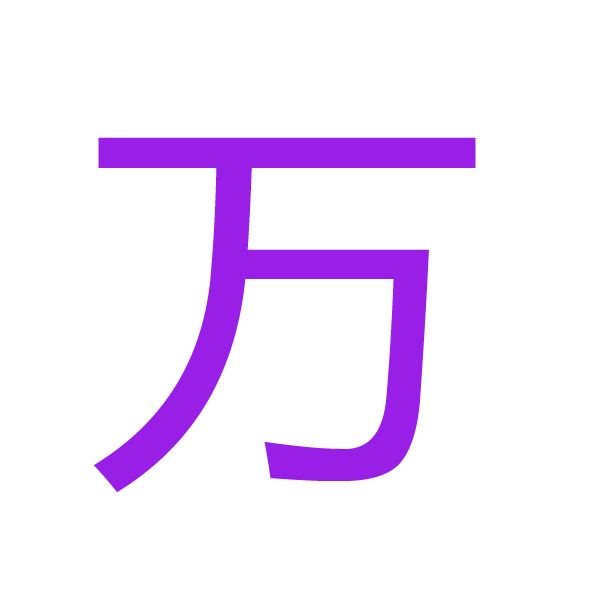
The Kanji: 万 (Man/Ban) - The "Ten Thousand" Kanji
1. Meaning and Usage
Core Meaning: Ten thousand; myriad; all; everything
Readings:
On'yomi (Chinese reading): マン (man), バン (ban)
Kun'yomi (Japanese reading): よろず (yorozu)
Common Words and Compounds:
一万 (いちまん / ichiman) - Ten thousand
万円 (まんえん / man'en) - Ten thousand yen
万年筆 (まんねんひつ / mannenhitsu) - Fountain pen ("ten thousand year pen")
万事 (ばんじ / banji) - Everything; all matters
万国 (ばんこく / bankoku) - All nations; international
2. Writing and Stroke Order: The Swastika's Simplicity
The correct kanji writing for "万" is deceptively simple but requires precision in stroke direction and proportion.
Stroke Order:
Stroke 1: A short horizontal stroke from left to right
Stroke 2: A horizontal折 (or) stroke - start horizontally, then turn sharply downward
Stroke 3: A left-falling stroke from the top-right
Significance of Correct Kanji Writing:
Stroke Direction: The second stroke's sharp turn is crucial - it should form a clean right angle
Balance: The three strokes should create a balanced, slightly wide character
Proportions: The first horizontal stroke should be shorter than the horizontal part of the second stroke
3. Historical Origin and Evolution
The history of "万" reveals one of the most interesting transformations in Chinese characters.
Oracle Bone Script (甲骨文字):
The earliest form was a pictogram of a scorpion, clearly showing the pincers, body, and curved tail.
Bronze Script (金文):
The form became more stylized but still retained the scorpion shape. The character was originally used for its sound rather than its meaning.
Seal Script (篆書):
The scorpion imagery began to fade as the character became more abstract and geometric.
Modern Form (楷書):
The modern "万" has completely lost its scorpion origins and now represents the number ten thousand through phonetic borrowing.
Phonetic Connection:
This is another example of the rebus principle:
The original word for "scorpion" sounded similar to the word for "ten thousand"
The scorpion character was borrowed for its sound to represent the large number
The original meaning of "scorpion" was eventually lost
Cultural Connection:
In Japanese culture, "万" carries profound significance:
Infinity and Abundance: Represents the concept of "myriad" or "countless" as in 万葉集 (Manyōshū) - Collection of Ten Thousand Leaves
Universality: Used in terms like 万物 (banbutsu) - all things in creation
Traditional Symbolism: 卍 (manji) - the Buddhist swastika symbol, represents eternity and good fortune
Everyday Usage: 万一 (man'ichi) means "if by any chance" - literally "one in ten thousand"
The character's journey from representing a dangerous creature to symbolizing infinite abundance demonstrates how cultural needs can completely transform a character's meaning while preserving its form.
Summary
The kanji "万" represents one of the most dramatic semantic shifts in Chinese character history. From its origins as a scorpion pictogram to its current meaning of "ten thousand" and "myriad," this character embodies the dynamic nature of written language evolution. Mastering its stroke order teaches important lessons about stroke direction and character balance in Japanese kanji writing. When you learn how to write kanji like "万," you're engaging with a symbol that connects ancient natural observations with abstract mathematical concepts - a character that transformed from representing a small creature to symbolizing infinite abundance, reflecting both the practicality and poetry of the Japanese writing system.