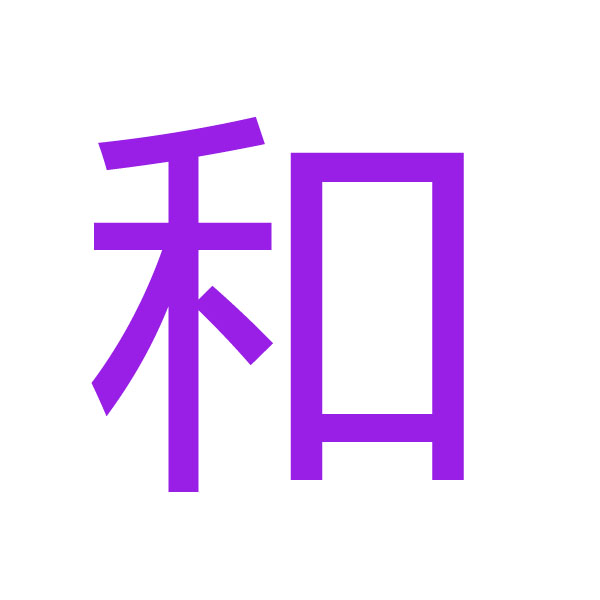
1. Kanji Breakdown: 和
This kanji represents one of the most fundamental concepts in Japanese culture and society.
Meaning: Harmony, peace, sum (addition); Japanese style. It signifies a state of peaceful coexistence, balance, and reconciliation. It is also the character used to denote things of Japanese origin.
Reading:
Onyomi (Sino-Japanese reading): ワ (wa), オ (o)
Kunyomi (Native Japanese reading): やわらぐ (yawaragu), なごむ (nagomu), やわらげる (yawarageru)
The kanji is a phono-semantic compound (形声文字). It consists of two parts:
Left (禾): This is the "grain" radical, representing a rice plant with a head of grain.
Right (口): This component means "mouth."
One common interpretation is that the character depicts "many mouths (people) sharing grain (food)," which is a fundamental basis for harmony and peace in a community.
2. Stroke Order and Writing
Learning the correct stroke order is crucial for balanced and beautiful kanji. "和" has 8 strokes.
Here is the stroke order diagram and explanation:
Total Strokes: 8
Start with the left radical "禾":
Then, write the right part "口":
Key Writing Tips:
Write from left to right, top to bottom.
The left radical "禾" is slightly wider and taller than the right part "口".
Pay attention to the balance. The right part "口" should be centered vertically with the "禾" radical.
The first stroke of "禾" is the left-falling stroke, not the horizontal one.
3. Vocabulary and Example Sentences
Here are some common words using "和" and how to use them in sentences.
Vocabulary
和 (わ, wa)
Meaning: Harmony, peace; Japan.
Example: チームの和を大切にする。
Romaji: Chīmu no wa o taisetsu ni suru.
English: We value the harmony of the team.
平和 (へいわ, heiwa)
Meaning: Peace (a state of non-war and tranquility).
Example: 世界の平和を願う。
Romaji: Sekai no heiwa o negau.
English: I pray for world peace.
和室 (わしつ, washitsu)
Meaning: Japanese-style room (with tatami mats).
Example: 和室でお茶を楽しんだ。
Romaji: Washitsu de ocha o tanonda.
English: We enjoyed tea in the Japanese-style room.
和食 (わしょく, washoku)
Meaning: Japanese cuisine.
Example: 和食はユネスコの無形文化遺産です。
Romaji: Washoku wa Yunesuko no mukei bunka isan desu.
English: Japanese cuisine is a UNESCO Intangible Cultural Heritage.
和解 (わかい, wakai)
Meaning: Reconciliation, settlement, amicable agreement.
Example: 両者はようやく和解に合意した。
Romaji: Ryōsha wa yōyaku wakai ni gōi shita.
English: The two parties finally agreed to a settlement.
和らげる (やわらげる, yawarageru)
Meaning: To soften, to moderate, to alleviate.
Example: 薬が痛みを和らげた。
Romaji: Kusuri ga itami o yawarageta.
English: The medicine alleviated the pain.
Summary
Kanji: 和
Core Meaning: Harmony, Peace, Japanese Style. It is a cornerstone of Japanese cultural identity.
Readings: On'yomi ワ (wa), Kun'yomi やわらぐ (yawaragu)
Stroke Order: 8 strokes. Remember to write the "禾" radical first, starting with the left-falling stroke.
This kanji is absolutely essential for understanding Japanese culture and society. By mastering its stroke order and vocabulary, you will be able to correctly write and use this deeply meaningful character.