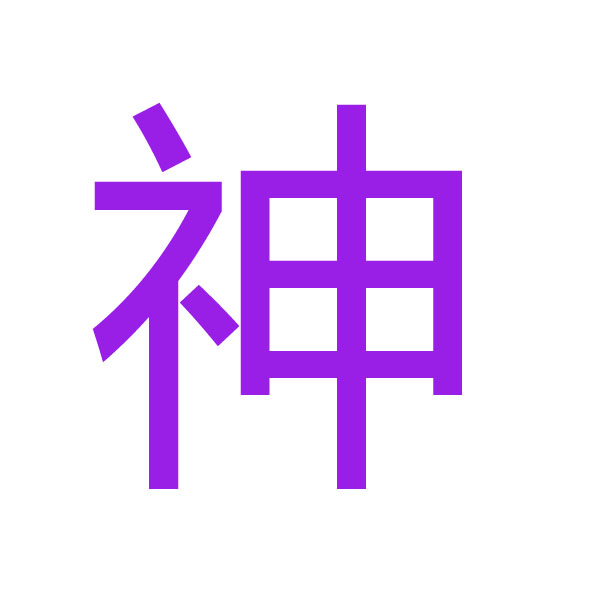
1. Kanji Breakdown: 神
This kanji represents one of the most fundamental concepts in Japanese culture and spirituality.
Meaning: God, deity, spirit, soul; divine, mysterious, supernatural.
Reading:
Onyomi (Sino-Japanese reading): シン (shin), ジン (jin)
Kunyomi (Native Japanese reading): かみ (kami)
The kanji is a phono-semantic compound (形声文字). It consists of two parts:
Left (示 / 礻): This is the "altar" or "spirit" radical (しめすへん), which relates to gods, worship, and spirituality.
Right (申): This means "to say" or "to speak," but its original form was a pictograph of a lightning bolt, symbolizing something divine and powerful from the heavens.
Thus, the character combines the ideas of the "spiritual/altar" (礻) and the "divine utterance/lightning" (申), representing a "divine spirit that manifests itself."
2. Stroke Order and Writing
Learning the correct stroke order is crucial for balanced and beautiful kanji. "神" has 9 strokes.
Here is the stroke order diagram and explanation:
Total Strokes: 9
Start with the left radical "礻" (altar radical):
Then, write the right part "申":
Key Writing Tips:
Write from left to right, top to bottom.
The left radical "礻" is narrower than the right part "申".
Pay attention to the balance. The right part "申" should be slightly larger and square.
The final vertical stroke (stroke 9) should be strong and centered, acting as the backbone of the character.
3. Vocabulary and Example Sentences
Here are some common words using "神" and how to use them in sentences.
Vocabulary
神 (かみ, kami)
Meaning: God, deity, spirit (in the Shinto sense).
Example: 日本人は昔から山や川に神が宿ると信じてきた。
Romaji: Nihonjin wa mukashi kara yama ya kawa ni kami ga yadoru to shinjite kita.
English: Japanese people have long believed that gods dwell in mountains and rivers.
神様 (かみさま, kamisama)
Meaning: God, deity (the honorific form, more polite and respectful than 神).
Example: 神様、どうか私の家族を守ってください。
Romaji: Kamisama, dōka watashi no kazoku o mamotte kudasai.
English: God, please protect my family.
精神 (せいしん, seishin)
Meaning: Spirit, mind, soul, psyche.
Example: 彼は精神が強い。
Romaji: Kare wa seishin ga tsuyoi.
English: He is strong in spirit (mentally strong).
神経 (しんけい, shinkei)
Meaning: Nerve; sensitivity.
Example: 彼は細かいことに神経を使う。
Romaji: Kare wa komakai koto ni shinkei o tsukau.
English: He pays close attention to small details (uses his nerves on small things).
神話 (しんわ, shinwa)
Meaning: Myth, mythology, legend.
Example: ギリシャ神話が好きだ。
Romaji: Girisha shinwa ga suki da.
English: I like Greek mythology.
神秘 (しんぴ, shinpi)
Meaning: Mystery, mysticism, the mysterious.
Example: 宇宙の神秘に魅了される。
Romaji: Uchū no shinpi ni miryō sareru.
English: I am fascinated by the mystery of the universe.
Summary
Kanji: 神
Core Meaning: God, Deity, Spirit. It represents the divine, the sacred, and the mysterious.
Readings: On'yomi シン (shin) / ジン (jin), Kun'yomi かみ (kami)
Stroke Order: 9 strokes. Remember it's composed of 礻 (left - spirit) and 申 (right - divine). Practice writing it step-by-step to master its form.
This kanji is central to understanding Japanese spirituality, from Shinto to everyday expressions. By mastering its stroke order and vocabulary, you will be able to correctly write and use this profoundly important character.