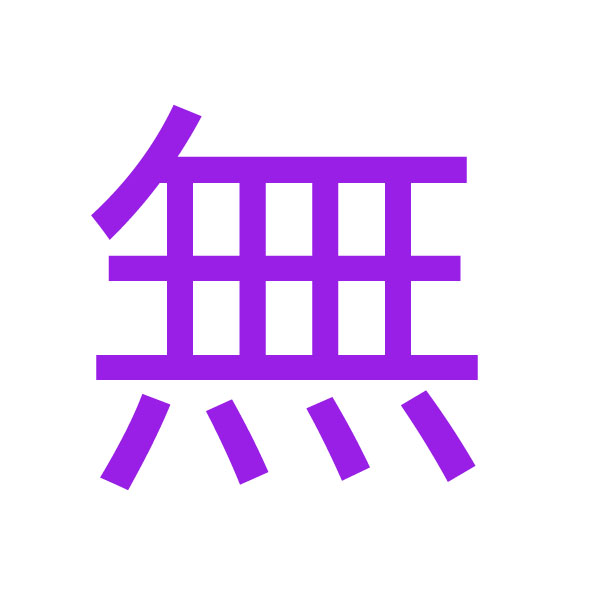
1. Kanji Breakdown: 無
This kanji represents one of the most fundamental and profound concepts in Japanese culture, especially influenced by Buddhism and Zen philosophy.
Meaning: Nothingness, nothing, nil, without, non-existence. It conveys the philosophical concept of "mu" - the void or emptiness that is a fundamental reality.
Reading:
Onyomi (Sino-Japanese reading): ム (mu), ブ (bu)
Kunyomi (Native Japanese reading): ない (nai)
The original form of this kanji is thought to be a pictograph of a person dancing with ornaments, which later evolved to mean "not having" those things, hence "nothing."
2. Stroke Order and Writing
Learning the correct stroke order is crucial for balanced and beautiful kanji. "無" has 12 strokes.
Here is the stroke order diagram and explanation:
Total Strokes: 12
Start with the top horizontal stroke.
The second horizontal stroke just below.
The third horizontal stroke just below.
The vertical stroke that cuts through all three horizontal strokes.
The two short vertical strokes on the left side (written as one sweeping motion in some styles).
The four dots at the bottom (usually written as three strokes: left, middle, right).
Key Writing Tips:
The top three horizontal strokes should be of similar length.
The central vertical stroke should be straight and centered.
The four dots at the bottom are crucial - they should be evenly spaced and have a slight upward trend from left to right.
The character should feel balanced and grounded.
3. Vocabulary and Example Sentences
Here are some common words using "無" and how to use them in sentences.
Vocabulary
無い (ない, nai)
Meaning: Non-existent, not having, there is not. (This is the adjective form).
Example: お金が無い。
Romaji: Okane ga nai.
English: I have no money. / There is no money.
無料 (むりょう, muryō)
Meaning: Free of charge, no cost.
Example: このサンプルは無料です。
Romaji: Kono sanpuru wa muryō desu.
English: This sample is free of charge.
無意味 (むいみ, muimi)
Meaning: Meaningless, pointless, senseless.
Example: これは無意味な議論だ。
Romaji: Kore wa muimi na giron da.
English: This is a meaningless argument.
無限 (むげん, mugen)
Meaning: Infinite, limitless, endless.
Example: 宇宙は無限に広がっている。
Romaji: Uchū wa mugen ni hirogatte iru.
English: The universe expands infinitely.
無関心 (むかんしん, mukanshin)
Meaning: Indifferent, unconcerned, apathetic.
Example: 彼は政治に無関心だ。
Romaji: Kare wa seiji ni mukanshin da.
English: He is indifferent to politics.
無我 (むが, muga)
Meaning: Selflessness, egolessness; total absorption in an activity.
Example: 無我の境地で絵を描いた。
Romaji: Muga no kyōchi de e o kaita.
English: I painted the picture in a state of selfless absorption.
Summary
Kanji: 無
Core Meaning: Nothingness, Without, Non-existence. (Also carries deep philosophical meaning from Zen Buddhism).
Readings: On'yomi ム (mu), ブ (bu); Kun'yomi ない (nai)
Stroke Order: 12 strokes. Focus on the three top horizontals, the central vertical, and the distinctive four dots at the bottom.
This kanji is essential for both everyday conversation and understanding deeper philosophical concepts in Japanese. By mastering its stroke order and vocabulary, you'll be able to express everything from simple negation to profound philosophical ideas.