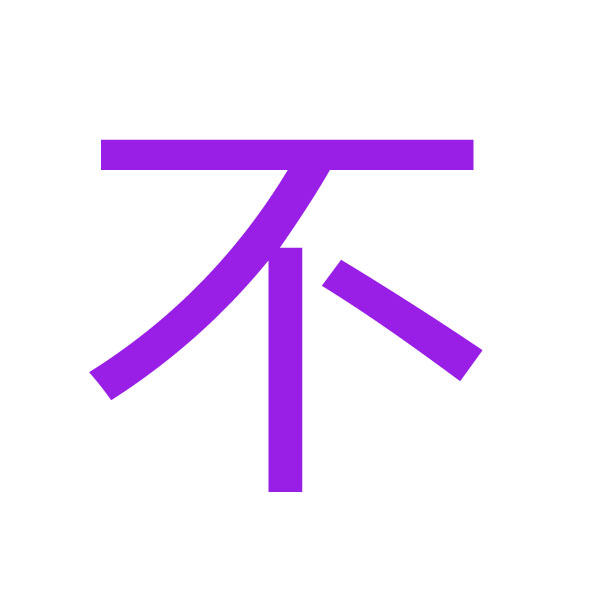
1. Kanji Breakdown: 不
This kanji is one of the most fundamental and frequently used negative prefixes in Japanese.
Meaning: Not, non-, un-; bad, poor. It is primarily used to negate or express the opposite of the word that follows it.
Reading:
Onyomi (Sino-Japanese reading): フ (fu), ブ (bu)
Kunyomi (Native Japanese reading): None in common modern use.
The etymology of "不" is pictographic. Its ancient form is thought to depict a "bird flying up into the sky and not wanting to come down." The character represents the bird's wings and body, symbolizing a state of negation or refusal. This evolved into its core grammatical function of expressing negation.
2. Stroke Order and Writing
Learning the correct stroke order is crucial for balanced and beautiful kanji. "不" has 4 strokes.
Here is the stroke order diagram and explanation:
Total Strokes: 4
The first horizontal stroke. (From left to right)
The left-falling stroke. (A long diagonal from the top-right)
The vertical stroke. (A straight line down the center)
The final right-falling stroke. (A short diagonal that acts as a dot)
Key Writing Tips:
Write from top to bottom.
The first horizontal stroke is the shortest.
The second stroke (the left-falling stroke) is the longest and most defining stroke of the character.
The final stroke is a short right-falling stroke, not a simple dot. It provides balance to the character.
3. Vocabulary and Example Sentences
Here are some common words using "不" and how to use them in sentences.
Vocabulary
不便 (ふべん, fuben)
Meaning: Inconvenient.
Example: 車がない生活は不便だ。
Romaji: Kuruma ga nai seikatsu wa fuben da.
English: Life without a car is inconvenient.
不満 (ふまん, fuman)
Meaning: Dissatisfaction, complaint.
Example: 彼は給料に不満を持っている。
Romaji: Kare wa kyūryō ni fuman o motte iru.
English: He is dissatisfied with his salary.
不可能 (ふかのう, fukanou)
Meaning: Impossible.
Example: それを一人でやるのは不可能だ。
Romaji: Sore o hitori de yaru no wa fukanou da.
English: It is impossible to do that alone.
不味い (まずい, mazui)
Meaning: Unappetizing, tastes bad; awkward (a situation).
Example: この料理は不味い。
Romaji: Kono ryōri wa mazui.
English: This dish tastes bad.
不安 (ふあん, fuan)
Meaning: Anxiety, uneasiness, insecurity.
Example: 試験の結果が不安だ。
Romaji: Shiken no kekka ga fuan da.
English: I feel anxious about the exam results.
不運 (ふうん, fuun)
Meaning: Bad luck, misfortune.
Example: 試合に負けるとは不運だった。
Romaji: Shiai ni makeru to wa fuun datta.
English: It was unfortunate that we lost the match.
Summary
Kanji: 不
Core Meaning: Not, Non-, Un- (a negative prefix).
Readings: On'yomi フ (fu), ブ (bu)
Stroke Order: 4 strokes. Focus on the long left-falling stroke and the balanced final stroke.
This kanji is absolutely essential for creating negative expressions in Japanese. By mastering its simple yet important stroke order and vocabulary, you will be able to correctly write and use this fundamental character in countless situations.