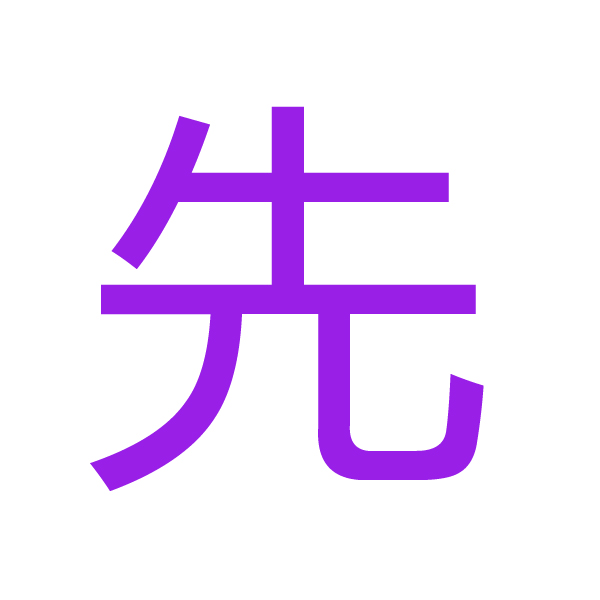
The Kanji: 先 (Saki/Sen) - The "Previous" and "Ahead" Kanji
The kanji "先" is an essential character representing concepts of priority, sequence, and direction. It embodies the ideas of what comes "before," "first," or "ahead" in both time and space.
1. Meaning and Usage
Core Meanings: Previous; ahead; former; future; tip; point.
Readings:
Kun'yomi (Japanese reading): さき (saki)
On'yomi (Chinese reading): セン (sen)
Common Words and Compounds:
先 (さき / saki) - The front; ahead; future; tip
先生 (せんせい / sensei) - Teacher; doctor (One who was "born before" - experienced)
先月 (せんげつ / sengetsu) - Last month
先週 (せんしゅう / senshū) - Last week
先輩 (せんぱい / senpai) - Senior; mentor
2. Writing and Stroke Order: Moving Forward
The correct kanji writing for "先" combines two simple components in a logical structure. Mastering its stroke order is straightforward but crucial.
Stroke Order:
Stroke 1: A short left-falling stroke.
Stroke 2: A short horizontal stroke, placed just below the first stroke.
Stroke 3: A long horizontal stroke, parallel to and below the second stroke.
Stroke 4: A left-falling stroke that starts from the center and sweeps down.
Stroke 5: A vertical折 (or) stroke that starts above, cuts through the long horizontal, and ends with a hook. This is the "stop" or "foot" component.
Significance of Correct Kanji Writing:
Balance: The top part (the first three strokes) should be compact but clear, while the bottom part needs enough space to stand firmly.
Component Recognition: The character can be seen as a combination of elements meaning "forward movement" and "stopping/standing," creating the concept of "that which is in front."
Foundation for Speed: This logical stroke order allows for quick, fluid writing while maintaining the character's recognizable shape.
3. Historical Origin and Evolution
The history of "先" vividly illustrates its core meaning through ancient imagery.
Oracle Bone Script (甲骨文字):
The original character was a clear pictograph showing a foot (止) above a person (人). This represented the concept of "stepping forward" or "going ahead" of someone else.
Bronze Script (金文) & Seal Script (篆書):
The form became more stylized but maintained the essential elements. The "foot" component evolved, and the "person" component became more abstract, but the relationship between them remained clear: one element moving ahead of the other.
Modern Form (楷書):
The modern "先" is a clean abstraction where:
The top part represents the evolved form of the "foot" stepping forward
The bottom part is the stylized "person" being preceded
The character perfectly preserves the original concept of something/someone being in front or before another.
Cultural and Conceptual Connection:
"先" holds deep cultural significance in Japanese society, particularly in hierarchical relationships:
先生 (Sensei): Honors someone who has gone "before" you in knowledge
先輩 (Senpai): Recognizes someone who has gone "before" you in experience
The character embodies respect for those who are ahead in journey, knowledge, or experience. It also represents the forward-looking nature of progress - always moving toward what lies "ahead" (先).
Summary
The kanji "先" is a character of movement and sequence. It began as a literal picture of a foot stepping ahead of a person and evolved into a sophisticated symbol for priority, both in time and space. Mastering its stroke order is an important step in Japanese kanji writing, as it teaches how to balance upward and downward extending elements. When you learn how to write kanji like "先," you are not just learning a character for "ahead" or "before"; you are learning a key to understanding Japanese social structure, where respect is given to those who have gone before, and progress is measured by what lies ahead.