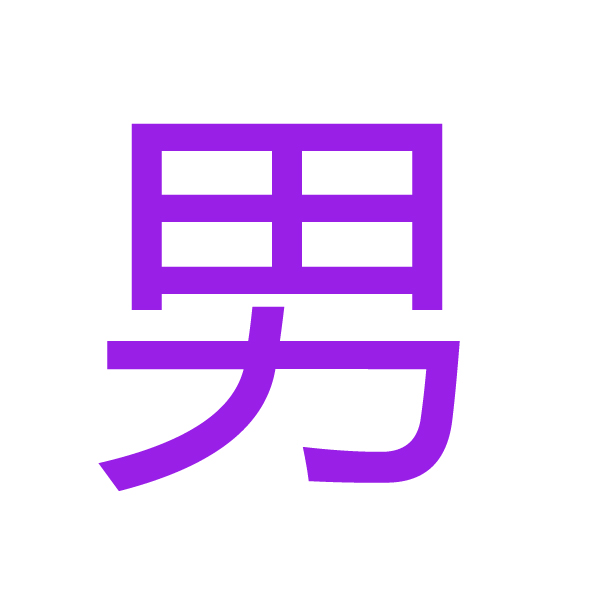
The Kanji: 男 (Otoko/Nan/Dan) - The "Man" Kanji
The kanji "男" is a fundamental character representing the concept of an adult male, man, or son. Its structure is a logical and powerful combination of two components that defined the primary societal role of men in ancient agrarian society.
1. Meaning and Usage
Core Meanings: Man; male; son.
Readings:
Kun'yomi (Japanese reading): おとこ (otoko)
On'yomi (Chinese reading): ダン (dan), ナン (nan)
Common Words and Compounds:
男 (おとこ / otoko) - Man; male
男の人 (おとこのひと / otoko no hito) - A man (person)
男子 (だんし / danshi) - Boy; young man
男女 (だんじょ / danjo) - Men and women
長男 (ちょうなん / chōnan) - Eldest son
2. Writing and Stroke Order: Strength in the Fields
The correct kanji writing for "男" is straightforward but requires attention to balance. It is composed of two distinct parts stacked on top of each other.
Stroke Order:
The character is composed of the top component 田 (rice field) and the bottom component 力 (power/strength).
Top Component (田 - Rice Field):
Stroke 1: Left vertical stroke.
Stroke 2: Top horizontal and right vertical stroke (one continuous stroke).
Stroke 3: Middle horizontal stroke.
Stroke 4: Middle vertical stroke.
Stroke 5: Bottom horizontal stroke.
Bottom Component (力 - Power/Strength):
Stroke 6: Left-falling stroke.
Stroke 7: A single stroke that starts as a horizontal line and turns sharply into a right-falling stroke with a hook at the end.
Significance of Correct Kanji Writing:
Proportions: The top 田 (field) and the bottom 力 (strength) should be of roughly equal height. The character should feel balanced and stable, not top-heavy or as if it's falling over.
Component Recognition: Understanding that the character means "power in the field" or "strength for the field" makes it incredibly easy to remember and write correctly.
Foundation: Mastering the stroke order for the components 田 and 力 is useful for many other kanji.
3. Historical Origin and Evolution
The history of "男" is a direct reflection of the socio-economic structure of ancient agricultural China.
Oracle Bone Script (甲骨文字):
The original character was a clear and logical ideogram. It combined:
田 (rice field)
力 (a pictogram of a plow or a strong arm)
The combined meaning was "one who uses a plow in the field" or "the physical strength (labor) in the field." In a society built on agriculture, this was the primary and most vital economic role, which was predominantly filled by men.
Bronze Script (金文) & Seal Script (篆書):
The form became more stylized. The "plow" shape of 力 became more standardized, and the 田 component remained clearly recognizable. The relationship between the two elements was maintained.
Modern Form (楷書):
The modern "男" is a clean and direct abstraction of its ancient form. The components are perfectly standardized. While the character 力 now means "power" or "strength" in a general sense, its origin as a farming tool is the key to understanding "男."
Cultural and Conceptual Connection:
The character "男" is deeply rooted in the Confucian ideal of gender roles that influenced much of East Asia. It encapsulates the historical concept of the man as the provider and pillar of the family, whose duty was to work the land and ensure its survival. This historical context explains the weight and responsibility often associated with the word.
While modern interpretations have evolved, the character's origin forever links the identity of a man to the concepts of strength, labor, and providing for the community.
Summary
The kanji "男" is a character whose form is its own etymology. It began as a literal depiction of the most important social role for men in an ancient agrarian society and evolved into the standard symbol for "man." Mastering its stroke order is a fundamental step in Japanese kanji writing, as it is a very common character. When you learn how to write kanji like "男," you are not just learning a word for "man"; you are learning a piece of social history, a character that encodes the ancient definition of masculinity as the strength that cultivates the land and sustains the community.