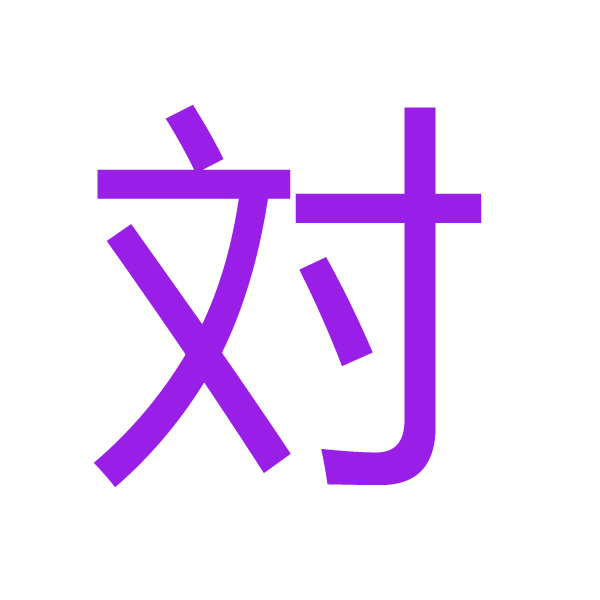
1. Meaning and Usage
The core meaning of the kanji 対 is "against," "opposite," "toward," or "pair." It represents a relationship between two entities, which can be one of opposition, correspondence, or comparison.
Common Readings and Words:
たい (tai): The Sino-Japanese reading used in compound words.
反対 (hantai): Opposition, against. (反-anti + 対-against)
対象 (taishō): Target, object. (対-toward + 象-appearance)
対話 (taiwa): Dialogue, conversation. (対-mutual + 話-speech)
対策 (taisaku): Countermeasure, measure against something. (対-against + 策-plan)
対して (taishite): Towards, against, regarding (a phrase used to indicate a target or counterpart).
つい (tsui): A less common reading, often found in words like:
対の (tsui no): A pair, a set of two.
2. Correct Stroke Order
Writing 対 correctly is essential for balance. It is the modern simplified form (新字体 shinjitai) of the traditional character 對. The stroke order is logical but should be practiced.
Total Strokes: 7
Step-by-Step Breakdown:
Left Component:
Stroke 1: Dot on the top (点).
Stroke 2: Horizontal stroke below the dot (横).
Stroke 3: Hooking stroke that goes down and left (a special stroke).
Right Component: 寸 (Sun)
Stroke 4: Horizontal stroke (横).
Stroke 5: Vertical hook stroke (竖钩).
Stroke 6: Dot on the lower right (点).
Key Stroke Order Rules Applied:
Left to Right: The entire left component is written before the right component 寸.
Top to Bottom: This rule governs the order within the left component.
3. Historical Origins and Etymology (The "Story" Behind the Kanji)
The history of 対 is fascinating. The modern form 対 is a simplification, so to understand its true origin, we must look at its traditional form: 對.
The character 對 is an ideographic compound (会意文字 kaii moji).
Let's break down the components of 對:
丵 (Saku): The top part of 對 is an old character representing a "carved ritual stand" or a "trophy." It symbolizes something formal and established.
寸 (Sun): This character means "hand" (specifically, a hand taking action, often in a measured or legal way). Its pictograph shows a hand with a mark near the wrist, indicating measurement.
The Combined Meaning:
The original meaning of 對/対 was "to respond correctly" or "to answer a sovereign's inquiry."
The imagery is that of a subject or vassal presenting a ritual stand (丵) with their hands (寸) in response to their lord's question. This was a formal, ceremonial act of giving a proper and respectful reply.
From this core idea of a formal "response," the meaning broadened:
Opposition: A response can be a counter-argument or a stance against something.
Correspondence: A response implies a relationship between two parties—a question and an answer, forming a pair.
Direction: The response is directed toward the one who asked the question.
Thus, the character evolved from a specific ceremonial action to represent any kind of binary relationship: opposition, correspondence, or comparison.
4. Example Sentences
Here are some example sentences showing the different uses of 対.
As "Against" (たい):
Romaji: Kare wa sono keikaku ni hantai shita.
English: He was against that plan.
彼はその計画に反対した。
As "Towards" (たい):
Romaji: Sensei ni taishite shitsurei na taido o totte wa ikenai.
English: You must not take a rude attitude towards your teacher.
先生に対して失礼な態度を取ってはいけない。
As "Target" (たい):
Romaji: Kono kōkoku no taishō wa wakamono desu.
English: The target of this advertisement is young people.
この広告の対象は若者です。
As "Pair" (つい):
Romaji: Tsui no isu o katta.
English: I bought a pair of chairs.
対の椅子を買った。
Summary
Meaning: Against, opposite, toward, pair.
Writing: 7 strokes. Write the left component first (dot, horizontal, hook), then the right component 寸.
Origin: A simplified form of 對. The original character was an ideographic compound depicting a formal act of "responding to a sovereign," showing a hand (寸) presenting a ritual stand (丵). This idea of a formal "response" to another party evolved into all its modern meanings involving binary relationships—be it opposition, correspondence, or pairing.