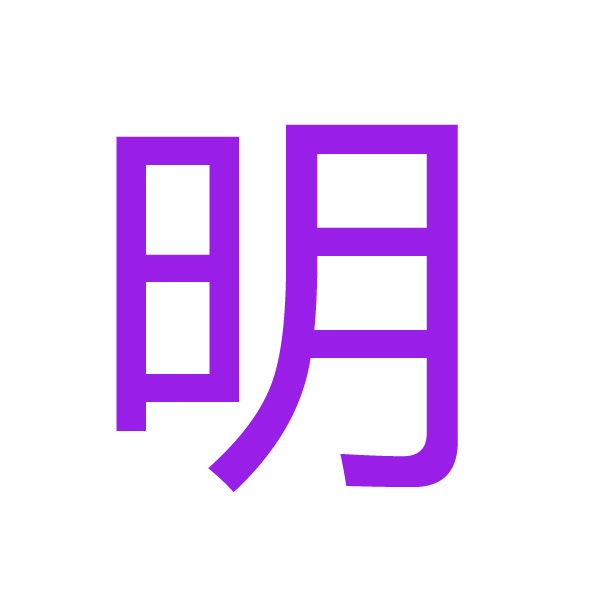
1. Meaning and Usage
The core meaning of the kanji 明 is "bright," "light," "clear," or "to understand." It represents both physical light and the metaphorical light of understanding and clarity.
Common Readings and Words:
めい (mei): The Sino-Japanese reading used in compound words.
明日 (ashita/myōnichi): Tomorrow. (See below for readings)
説明 (setsumei): Explanation. (説-explain + 明-clear → "to make clear")
明白 (meihaku): Obvious, clear. (明-bright + 白-white)
文明 (bunmei): Civilization. (文-writing + 明-bright → "enlightened culture")
みょう (myō): An alternative Sino-Japanese reading, most notably in:
明日 (myōnichi/ashita): Tomorrow.
あ (a): The native Japanese reading used in verbs and adjectives.
明るい (akarui): Bright, cheerful.
明かり (akari): Light, illumination.
2. Correct Stroke Order
Writing 明 correctly is essential for balance. The kanji is composed of two equal parts placed side-by-side: 日 (hi) and 月 (tsuki).
Total Strokes: 8
Step-by-Step Breakdown:
Left Component: 日 (Hi - Sun/Day)
Stroke 1: Left vertical stroke (竖).
Stroke 2: Top horizontal and right vertical in one stroke (横折).
Stroke 3: Middle horizontal stroke (横).
Stroke 4: Bottom horizontal stroke (横).
Right Component: 月 (Tsuki - Moon)
Stroke 5: Left vertical stroke (竖).
Stroke 6: Top horizontal and right vertical in one stroke (横折).
Stroke 7: Top inner horizontal stroke (横).
Stroke 8: Bottom inner horizontal stroke (横).
Key Stroke Order Rules Applied:
Left to Right: The entire left component 日 is written before the right component 月.
Top to Bottom: This rule governs the order within each component.
Enclose before Close: The outer structure of each component is written before the inner strokes.
3. Historical Origins and Etymology (The "Story" Behind the Kanji)
The history of 明 is a beautiful and classic example of an ideographic compound (会意文字 kaii moji), where the meaning is derived from the combination of two pictographs.
The kanji 明 is composed of two of the most fundamental celestial bodies:
日 (Hi): The "sun," the source of all daylight.
月 (Tsuki): The "moon," which reflects the sun's light to illuminate the night.
The Combined Meaning:
The meaning of 明 is created by the powerful combination of these two elements:
"The light of the sun (日) and the moon (月) together."
This creates the ultimate expression of "brightness." What could be brighter or more illuminating than having both the sun and the moon shining? This character signifies a world filled with light, leaving no room for darkness.
From this original meaning of physical light, the meaning expanded metaphorically:
Clarity: Something that is "bright" is easy to see and therefore "clear."
Understanding: When a difficult concept becomes "clear" in your mind, it is like a light turning on. You "understand" it.
The character 明 is a poetic and profound representation of enlightenment in every sense of the word.
4. Example Sentences
Here are some example sentences showing the different uses of 明.
As "Bright" (あかるい):
Romaji: Kono heya wa totemo akarui.
English: This room is very bright.
この部屋はとても明るい。
As "Explanation" (めい):
Romaji: Riyū o setsumei shite kudasai.
English: Please explain the reason.
理由を説明してください。
As "Tomorrow" (みょう):
Romaji: Ashita/Myōnichi aimashō.
English: Let's meet tomorrow.
明日会いましょう。
As "Light" (あかり):
Romaji: Akari o keshite neta.
English: I turned off the light and went to sleep.
明かりを消して寝た。
Summary
Meaning: Bright, light, clear, to understand.
Writing: 8 strokes. Write the left "sun" component 日 first, then the right "moon" component 月.
Origin: An ideographic compound that is a masterpiece of simplicity and power. It combines 日 (sun) and 月 (moon) to represent the ultimate "brightness" and illumination, which naturally extends to meanings of "clarity" and "understanding."