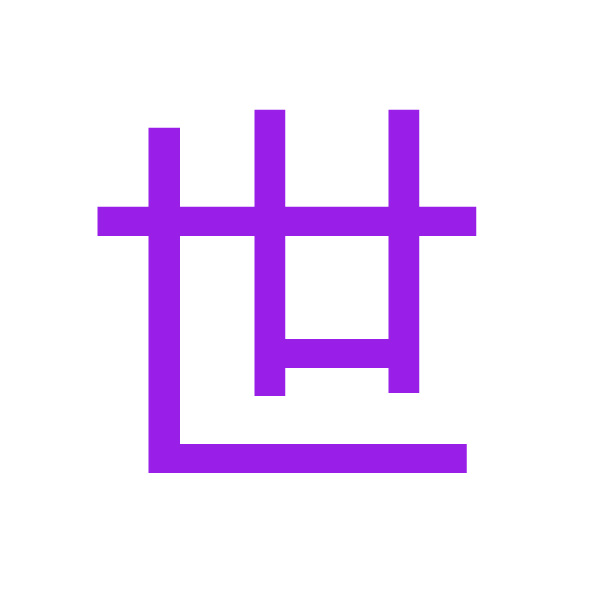
1. Meaning and Usage
The core meaning of the kanji 世 is "world," "society," "generation," or "age." It represents the concept of the human world and the passage of time through generations.
Common Readings and Words:
よ (yo): The native Japanese reading.
世の中 (yo no naka): The world, society. (Lit: "The inside of the world")
世話 (sewa): Help, care, looking after. (This word uses the on'yomi for the first character in a kun'yomi reading).
せい (sei): The Sino-Japanese reading used in compound words.
世界 (sekai): The world. (世-generation + 界-boundary → "a bounded generation/age")
世紀 (seiki): Century. (世-generation + 紀-period → "a generational period")
世代 (sedai): Generation. (世-generation + 代-era)
2. Correct Stroke Order
Writing 世 correctly is straightforward. Its structure is simple but must be written in the correct order to look balanced.
Total Strokes: 5
Step-by-Step Breakdown:
Stroke 1: The top horizontal stroke. Write from left to right (横).
Stroke 2: The vertical stroke. Start from the top and go down, slightly to the left of the center (竖).
Stroke 3: The middle horizontal stroke. Write from left to right, connecting to the vertical (横).
Stroke 4: The bottom-left short vertical stroke (竖).
Stroke 5: The final bottom horizontal stroke. Write from left to right, connecting to the previous vertical (横).
Key Stroke Order Rules Applied:
Top to Bottom: The character is written from the top down.
Left to Right: The horizontal strokes are written from left to right.
3. Historical Origins and Etymology (The "Story" Behind the Kanji)
The history of 世 is a brilliant example of a 指事文字 (shiji moji) or ideographic character, where the symbol is a simplified representation of an abstract idea.
The Origin:
The kanji 世 is derived from an ancient form of the character 枼 (yō), which meant "leaf." However, 世 itself was created as an abstraction.
It is composed of three of the same element: 十 (ten) or 十 (juu), which means "ten."
The Combined Meaning:
The character 世 visually represents:
"Thirty years."
In ancient times, a generation was considered to be roughly thirty years. The character 世 was formed by taking three "tens" (十 + 十 + 十) and linking them together into a single, flowing character. This created a powerful symbol for a "generation" or an "age."
From this core meaning of a "generation," the meaning naturally expanded:
From "Generation" to "Society": The world is made up of multiple, successive generations living together.
From "Generation" to "Age/Era": A period defined by the people living in it.
From "Generation" to "The World": The entire scope of human existence across time.
Thus, this simple character of three connected tens encapsulates the flow of time, human lineage, and the entirety of human society.
4. Example Sentences
Here are some example sentences showing the different uses of 世.
As "The World" (よ):
Romaji: Yo no naka wa hiroi.
English: The world is a big place.
世の中は広い。
As "Century" (せい):
Romaji: Ima wa nijū-isseiki desu.
English: Now is the 21st century.
今は二十一世紀です。
As "Generation" (せい):
Romaji: Watashi no sedai wa intānetto de sodatta.
English: My generation grew up with the internet.
私の世代はインターネットで育った。
As "Help/Care" (せわ):
Romaji: Kodomo no sewa o suru.
English: To look after children.
子供の世話をする。
Summary
Meaning: World, society, generation, age.
Writing: 5 strokes. Write from top to bottom: the top horizontal, then the vertical, followed by the middle horizontal, the bottom-left vertical, and finally the bottom horizontal.
Origin: An ideographic character. It originated from the concept of "thirty years" (three tens: 十十十), which was considered the length of a generation. This meaning expanded to encompass the world built by successive generations and the ages they live in.