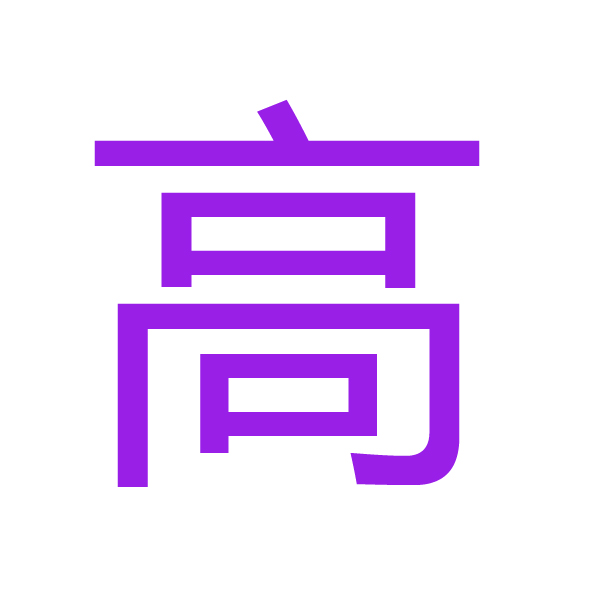
The Kanji: 高 (Taka.i/Kō) - The "High/Tall" Kanji
1. Meaning and Usage
Core Meanings: High; tall; expensive; superior
Readings:
Kun'yomi (Japanese reading): たか.い (taka.i)
On'yomi (Chinese reading): コウ (kō)
Common Words and Compounds:
高い (たかい / takai) - High; tall; expensive
高校 (こうこう / kōkō) - High school
最高 (さいこう / saikō) - Highest; best
高速 (こうそく / kōsoku) - High-speed
高温 (こうおん / kōon) - High temperature
2. Writing and Stroke Order: The Towering Structure
The correct kanji writing for "高" follows a clear structure that visually represents its meaning.
Stroke Order:
Stroke 1: Right dot
Stroke 2: Left dot
Stroke 3: Long horizontal stroke
Stroke 4: Short vertical stroke on left
Stroke 5: Short vertical stroke on right
Stroke 6: Short horizontal stroke inside
Stroke 7: Vertical折 through center
Stroke 8: Short horizontal stroke at bottom-left
Stroke 9: Short horizontal stroke at bottom-right
Stroke 10: Final horizontal stroke closing the base
Significance of Correct Kanji Writing:
Enclosure Structure: Follows the "create frame first" principle
Vertical Emphasis: The central vertical stroke creates height
Balance: Multiple horizontal strokes must be parallel and evenly spaced
3. Historical Origin and Evolution
The history of "高" reveals a clear architectural origin.
Oracle Bone Script (甲骨文字):
The earliest form depicted a tall watchtower or multi-story building with:
A raised platform base
Multiple stories
A roof or upper level
Often showed entrance gates or windows
Bronze Script (金文):
The form became more stylized but maintained the tower-like structure with clear multiple levels.
Seal Script (篆書):
The character evolved into a more standardized form while preserving the essential multi-story building appearance.
Modern Form (楷書):
The modern "高" maintains the tall, enclosed structure with clearly defined stories.
Conceptual Evolution:
The character's meaning expanded through natural associations:
Physical Height (tall buildings) → Abstract Height (high quality)
Elevated Position → Superior Status
Physical Elevation → High Price/Cost
Cultural Significance:
In Japanese culture, "高" carries important social and economic meanings:
Social Status: Associated with high rank and superiority
Quality Assessment: Used in evaluating excellence (最高 - the best)
Economic Value: Directly connects height with expense
Educational Hierarchy: 高校 represents advanced education level
The character perfectly captures how physical elevation translates into abstract concepts of quality and status.
Summary
The kanji "高" represents a clear evolution from architectural observation to abstract valuation. Beginning as a pictogram of a tall watchtower - the most visibly elevated structure in ancient settlements - it evolved to encompass all forms of height, excellence, and elevated status. Mastering its stroke order and multi-level structure teaches important principles of Japanese kanji writing. When you learn how to write kanji like "高," you're engaging with a character that connects ancient urban architecture with modern concepts of quality and value. This character serves as a powerful reminder that our abstract assessments of "high quality" or "superior status" are deeply rooted in the physical experience of looking up at tall structures - from the watchtowers that provided security in ancient cities to the skyscrapers that define modern urban landscapes, "高" continues to represent both physical elevation and abstract excellence in Japanese thought and language.