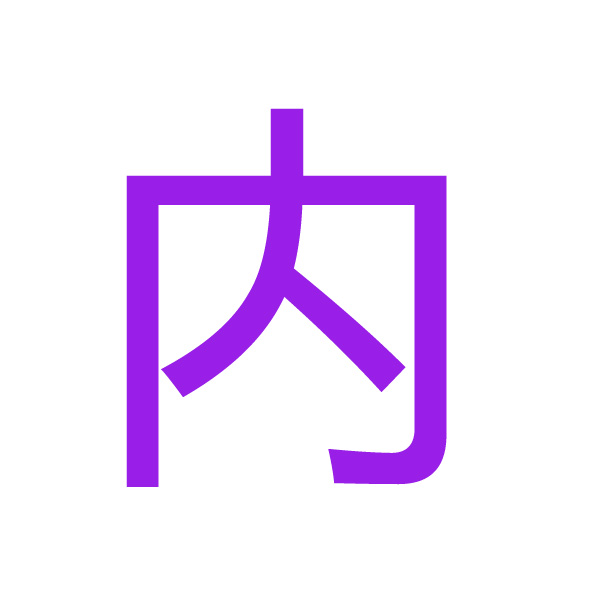
1. Meaning and Usage
The core meaning of the kanji 内 is "inside," "within," "interior," or "during." It represents the concept of an enclosed space, both in physical and abstract terms, and is the direct opposite of 外 (soto - outside).
Common Readings and Words:
ない (nai): The Sino-Japanese reading used in compound words.
内容 (naiyō): Content, subject matter. (内-inside + 容-form)
内心 (naishin): One's true feelings, inner thoughts. (内-inside + 心-heart)
室内 (shitsunai): Indoors, inside a room. (室-room + 内-inside)
内閣 (naikaku): Cabinet (of a government). (内-inside + 閣-building → "the inner building/government")
うち (uchi): The native Japanese reading.
内 (uchi): The basic word for "inside," "interior." It can also mean "one's home," "one's family," or "during."
家の中 (ie no naka): Inside the house. (While 中 is also "inside," 内 has a stronger sense of a defined boundary or group).
2. Correct Stroke Order
Writing 内 correctly is straightforward and follows fundamental principles. The kanji is composed of an enclosing radical 冂 (kei-gamae) and the internal component 入 (iru).
Total Strokes: 4
Step-by-Step Breakdown:
Stroke 1: Left vertical stroke. Write from top to bottom (竖).
Stroke 2: The horizontal折 (oritsu). This stroke forms the top and the right side of the enclosure. Start from the left, write the top horizontal, then turn and go down the right side.
Stroke 3: The left-falling stroke (撇) inside the enclosure.
Stroke 4: The right-dot stroke (捺) inside the enclosure.
Key Stroke Order Rules Applied:
Enclose before Close: The outer structure (Strokes 1 and 2) is established before the internal components are filled in.
Left to Right: The two internal strokes are written from left to right.
3. Historical Origins and Etymology (The "Story" Behind the Kanji)
The history of 内 is a clear example of an ideographic compound (会意文字 kaii moji), where the meaning is logically derived from its parts.
Let's break down its original components:
冂 (Kei-gamae): This radical represents an "enclosure," "boundary," or "border." It sets the stage for the concept of a defined space.
入 (Iru): This character means "to enter." Its original pictograph was of an arrowhead, symbolizing something piercing and going into a target.
The Combined Meaning:
The character 内 creates a perfectly logical scene:
"To enter (入) an enclosure (冂)."
What is the space you are in after you have entered a boundary? You are inside. This simple yet powerful imagery is the direct source of the kanji's meaning.
Evolution of Meaning:
From this core idea of "the space within a boundary," the meaning expanded:
Physical Space: The inside of a room (室内).
Abstract Space: One's inner feelings (内心).
Social Groups: A group defined by a boundary, such as one's family (家内 kanai - my wife [inside the house]) or company (社内 shanai - within the company).
Time: A period within a time boundary (年内 nenchū - within the year).
4. Example Sentences
Here are some example sentences showing the different uses of 内.
As "Inside" (うち):
Romaji: Uchi to soto de ondo ga chigau.
English: The temperature is different inside and outside.
内と外で温度が違う。
As "During" (うち with に):
Romaji: Kuraku naranai uchi ni kaerimashō.
English: Let's go home before it gets dark. (Within the time period before it gets dark).
暗くならない内に帰りましょう。
In a Compound Word (ない):
Romaji: Kare no naishin wa wakaranai.
English: I don't know what he's really thinking (his inner heart).
Romaji: Kono hako no naiyō wa nan desu ka?
English: What is the content of this box?
この箱の内容は何ですか。
彼の内心はわからない。
Summary
Meaning: Inside, within, interior, during.
Writing: 4 strokes. Write the enclosing structure first (left and top-right), then the internal 入 component.
Origin: An ideographic compound that visually represents the concept of "entering (入) an enclosure (冂)." This simple action defines the state of being inside, which forms the basis for all its modern physical, abstract, social, and temporal meanings.