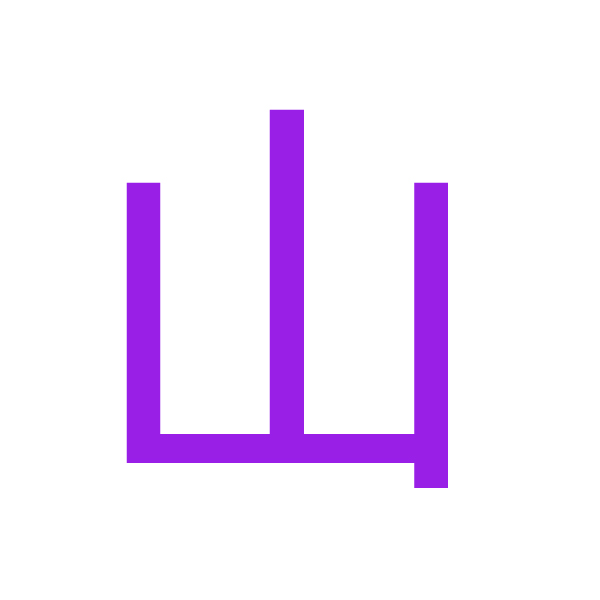
The Kanji: 山 (Yama/San) - The "Mountain" Kanji
The kanji "山" is one of the most fundamental and visually intuitive characters in Japanese. It is a direct pictogram representing a "mountain." Its simplicity and recognizable form have made it a stable and essential character for millennia.
1. Meaning and Usage
Core Meanings: Mountain; peak.
Readings:
Kun'yomi (Japanese reading): やま (yama)
On'yomi (Chinese reading): サン (san)
Common Words and Compounds:
山 (やま / yama) - Mountain
火山 (かざん / kazan) - Volcano (Fire Mountain)
富士山 (ふじさん / Fujisan) - Mount Fuji
登山 (とざん / tozan) - Mountain climbing
山林 (さんりん / sanrin) - Mountain forest
2. Writing and Stroke Order: The Three Peaks
The correct kanji writing for "山" is simple but must be executed with attention to proportion and balance to capture the majestic shape of a mountain range.
Stroke Order:
Stroke 1: The central peak. A vertical stroke from top to bottom. This is the tallest stroke, representing the main peak.
Stroke 2: The left ridge. A vertical折 (or) stroke. Start with a short horizontal line that connects to the base of the central peak, then turn sharply downward.
Stroke 3: The right ridge. Another vertical折 (or) stroke, mirroring the second stroke on the right side. It also connects to the base of the central peak.
Significance of Correct Kanji Writing:
Balance and Proportion: The central vertical stroke (1) should be the tallest, with the two side strokes (2 & 3) being shorter and symmetrical. This creates the classic triangular silhouette of a mountain.
Stability: The character should have a wide, stable base, visually grounding it. This is achieved by the horizontal parts of the second and third strokes.
Visual Representation: The stroke order naturally builds the character from the highest point downward, creating a shape that is instantly recognizable as a mountain with multiple peaks.
3. Historical Origin and Evolution
The history of "山" is a perfect demonstration of a pictogram's journey from a detailed drawing to a stylized symbol.
Oracle Bone Script (甲骨文字):
The earliest form was a vivid pictogram of a mountain range with three distinct peaks. The central peak was often drawn highest, clearly conveying the idea of multiple summits rising from the earth.
Bronze Script (金文) & Seal Script (篆書):
The form became more stylized and artistic. The three peaks remained, but the lines became thicker and more symbolic. The connection between the peaks was sometimes emphasized, turning them into a more unified range.
Modern Form (楷書):
The modern "山" is a clean and minimalist abstraction. The three peaks of the original drawing have been perfectly standardized into the three strokes we use today. While highly stylized, the character has successfully retained the essential concept of a multi-peaked mountain for over 3,000 years.
Cultural and Spiritual Connection:
In Japanese culture, mountains (山) are not just geographical features; they are sacred spaces.
Sacred Sites: Mountains have long been central to Shinto and Buddhist practices. They are seen as dwelling places of gods (kami) and are sites for pilgrimage and ascetic training.
Aesthetic Symbol: The mountain is a core element in Japanese art, poetry, and garden design, representing eternity, stability, and challenge.
National Identity: Japan is a mountainous country, and this character is deeply embedded in its culture and place names (e.g., Yamaguchi, Yamamoto).
Summary
The kanji "山" is a character of elegant simplicity and profound cultural significance. It began as a literal drawing of a mountain range and evolved into one of the most efficient and recognizable symbols in the Japanese writing system. Mastering its stroke order and balanced proportions is a fundamental step in Japanese kanji writing. When you learn how to write kanji like "山," you are not just learning a word for a geographical feature; you are learning a character that represents stability, sacredness, and the very backbone of the Japanese archipelago. It is a testament to the enduring power of pictorial writing.