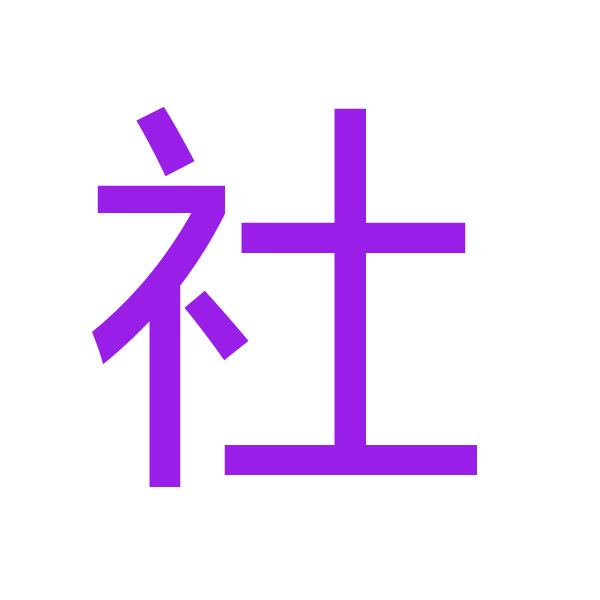
1. Meaning and Usage
The core meaning of the kanji 社 is "company," "firm," "society," or "shrine." It represents an organized group of people, from a deity's association (shrine) to a commercial organization (corporation).
Common Readings and Words:
しゃ (sha): The Sino-Japanese reading used for organizations and compounds.
会社 (kaisha): Company, corporation. (会-association + 社-society)
社会 (shakai): Society. (社-society + 会-association)
社員 (shain): Company employee. (社-company + 員-member)
神社 (jinja): Shinto shrine. (神-god + 社-shrine)
やしろ (yashiro): The native Japanese reading for "shrine."
2. Correct Stroke Order
Writing 社 correctly is straightforward and follows fundamental principles. The kanji is composed of the left radical ネ (示 - altar) and the right component 土 (tsuchi - earth).
Total Strokes: 7
Step-by-Step Breakdown:
Left Radical: ネ (Shimesu-hen - To Show/Altar)
Stroke 1: Dot on the top (点).
Stroke 2: Horizontal stroke below the dot (横).
Stroke 3: Left-falling stroke (撇) from the center.
Stroke 4: Right-dot stroke (捺) for balance.
Right Component: 土 (Tsuchi - Earth)
Stroke 5: Short horizontal stroke (横).
Stroke 6: Vertical stroke (竖) from top to bottom, starting from the center of stroke 5.
Stroke 7: Long horizontal stroke at the bottom (横). Note: The bottom horizontal is longer than the top one.
Key Stroke Order Rules Applied:
Left to Right: Complete the left radical ネ before starting the right component 土.
Top to Bottom: This rule governs the order within both components.
3. Historical Origins and Etymology (The "Story" Behind the Kanji)
The history of 社 is a beautiful example of how a kanji's meaning evolves from a spiritual concept to a secular one. It is an ideographic compound (会意文字 kaii moji).
Let's break down its original components:
ネ / 示 (Shimesu): This radical originally depicted an altar or a sacred stone table used for making offerings to the gods. It is associated with deities, spirits, and the divine.
土 (Tsuchi): This character means "earth," "soil," or "ground."
The Combined Meaning:
The original meaning of 社 was the "earth god" or the "god of the land." It specifically referred to the tutelary deity (the protective spirit) of a particular locality or village.
From this, the meaning expanded to refer to the sacred ground or the shrine where this earth god was worshipped. A 社 (yashiro) was a place where the community gathered to venerate the deity that protected their land and society.
Evolution to Modern Meaning:
The logical progression is clear:
First, it was the earth god itself.
Then, it became the sacred place (shrine) for that god.
As people gathered at this shrine, it became the focal point of the community, representing the community itself.
Finally, this concept of an "organized community" was extended to the modern, secular "company" (会社) or "society" (社会).
A 会社 (kaisha) is, in essence, a group of people "associated" (会) in a "community" (社). This shows a direct lineage from ancient spiritual gatherings to modern corporate structures.
4. Example Sentences
Here are some example sentences showing the different uses of 社.
As "Company" (しゃ):
Romaji: Kare wa atarashii kaisha ni tsutomete imasu.
English: He works for a new company.
彼は新しい会社に勤めています。
As "Shrine" (やしろ):
Romaji: Sono o-yashiro wa mori no okufukaku ni arimasu.
English: That shrine is deep within the forest.
そのお社は森の奥深くにあります。
In a Compound Word (しゃ):
Romaji: Shakai no yaku ni tachitai.
English: I want to be useful to society.
社会の役に立ちたい。
Summary
Meaning: Company, society, firm, shrine.
Writing: 7 strokes. Write the left "altar" radical ネ first, then the right "earth" component 土.
Origin: An ideographic compound representing the "earth god" or the "god of the land," combining the altar (ネ/示) and earth (土) radicals. It evolved from meaning the deity itself, to the shrine for that deity, to the community that worshipped there, and finally to any organized group like a company or society.