1. Meaning and Usage
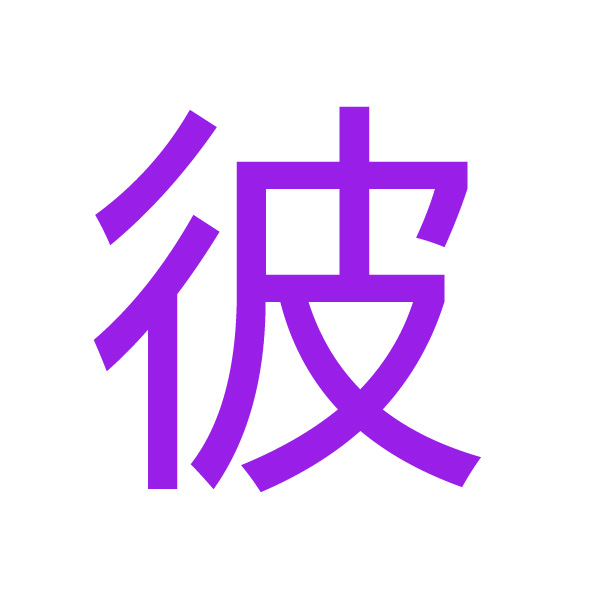
The core meaning of the kanji 彼 is "he," "him," "that," or "the other." It functions as the primary third-person masculine pronoun and is also used to refer to things or people that are distant ("that one over there").
Common Readings and Words:
かれ (kare): He, him (the standard male pronoun).
彼女 (kanojo): She, her; girlfriend. (彼-he + 女-woman) Note how 彼 changes the meaning of 女.
彼ら (karera): They, them (referring to people).
かの (kano): An archaic or literary prefix meaning "that..." or "the..."
彼の (kano): That [thing/person] (literary).
彼方 (kanata): The other side; beyond. (彼-that + 方-direction)
ひ (hi): A rare Sino-Japanese reading found in some Buddhist terms.
彼岸 (higan): The Buddhist equinox festival; the "other shore" of enlightenment. (彼-that + 岸-shore)
2. Correct Stroke Order
Writing 彼 correctly is essential for balance. The kanji is composed of the left radical 彳 (gyōninben) and the right component 皮 (kawa).
Total Strokes: 8
Step-by-Step Breakdown:
Left Radical: 彳 (Gyōninben - Step)
Stroke 1: Short left-falling stroke (撇).
Stroke 2: Short left-falling stroke (撇), just below and parallel to the first.
Stroke 3: Vertical stroke (竖) from top to bottom. This three-stroke radical is crucial and distinguishes it from the "person" (人) radical.
Right Component: 皮 (Kawa - Skin)
Stroke 4: A horizontal hook. Start with a short horizontal and then hook down.
Stroke 5: Left-falling stroke (撇) from the top-left.
Stroke 6: Short vertical stroke (竖) in the center.
Stroke 7: Right-falling stroke (捺). This is a long, sweeping stroke that provides balance.
Stroke 8: A short dot or dash on the lower right. Note: The stroke order for 皮 is unique and must be practiced.
Key Stroke Order Rules Applied:
Left to Right: Complete the left radical 彳 before starting the right component 皮.
Top to Bottom: This rule governs the order within both components.
3. Historical Origins and Etymology (The "Story" Behind the Kanji)
The history of 彼 is a fantastic example of meaning abstraction. It is classified as a 形声文字 (keisei moji) or phonetic-ideographic compound.
Let's break down its components:
Semantic Component (Meaning): 彳 (Gyōninben)
This radical is a simplified form of 行 (to go, to walk). It represents a footstep or a road. Its presence indicates that the character's original meaning was related to movement, a path, or a direction.
Phonetic Component (Sound): 皮 (Kawa)
This component means "skin" or "hide," but in 彼, its primary role was to provide the ancient Chinese pronunciation, which was similar to the word for "that."
The Evolution of Meaning:
The original meaning of 彼 was not "he," but "to go to that place" or "that which is over there."
The "footstep" radical (彳) gave the idea of movement or a distant path.
The phonetic component (皮) provided the sound and reinforced the idea of "that."
So, the character originally pointed to a distant location ("that place over there"). This spatial meaning is still visible in words like 彼方 (kanata), meaning "the other side" or "beyond."
From referring to a distant place, the meaning naturally expanded to refer to a distant person—"that person over there." This is a common linguistic shift (from spatial to personal). Eventually, "that person" became solidified as the third-person pronoun "he" (and with 女, "she").
4. Example Sentences
Here are some example sentences showing the different uses of 彼.
As "He" / "Him" (かれ):
Romaji: Kore o kare ni watashite kudasai.
English: Please give this to him.
Romaji: Kare wa isha desu.
English: He is a doctor.
彼は医者です。
これを彼に渡してください。
As "Boyfriend":
Romaji: Kare ga dekimashita.
English: I got a boyfriend. (Lit: A "he" has been made/acquired.)
彼ができました。
In a Compound Word (かの):
Romaji: Kano chi o tabi suru.
English: To travel to that land (a literary expression).
彼の地を旅する。
Summary
Meaning: He, him, that, the other.
Writing: 8 strokes. Write the left "step" radical 彳 first, then the right component 皮, paying close attention to the unique stroke order of 皮.
Origin: A phonetic-ideographic compound. It originally meant "that place over there," combining the "footstep" radical (彳) for movement/distance with the phonetic 皮. The meaning shifted from a distant place to a distant person, eventually becoming the standard pronoun "he."