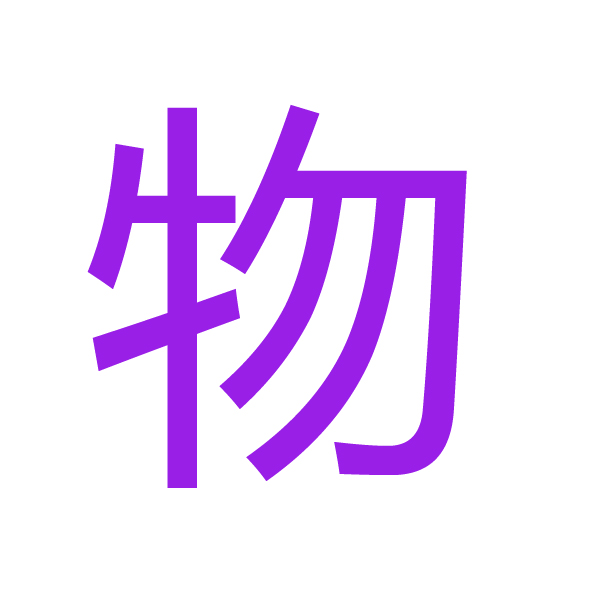
1. Meaning and Usage
The core meaning of the kanji 物 is "thing," "object," "matter," or "substance." It is one of the most fundamental and widely used kanji, representing physical objects, abstract matters, and even living creatures in a general sense.
Common Readings and Words:
もの (mono): The native Japanese reading, meaning "thing."
物語 (monogatari): Story, tale. (物-thing + 語-narrate → "a narration of things/events")
食べ物 (tabemono): Food. (食-eat + 物-thing)
ぶつ (butsu): The Sino-Japanese reading used in compound words.
物質 (busshitsu): Matter, substance. (物-thing + 質-quality)
動物 (dōbutsu): Animal. (動-move + 物-thing → "moving thing")
植物 (shokubutsu): Plant. (植-plant + 物-thing → "planted thing")
物品 (buppin): Goods, articles.
もつ (motsu): The verb "to hold" or "to carry," though this is written with the kanji 持つ. The connection is historical and etymological.
2. Correct Stroke Order
Writing 物 correctly requires attention to its two radical components. The correct stroke order ensures balance and legibility.
Total Strokes: 8
Step-by-Step Breakdown:
Left Radical: 牛 (Ushi-hen - Cow)
Stroke 1: Short left-falling stroke (撇).
Stroke 2: Short horizontal stroke (横).
Stroke 3: Long vertical stroke (竖) from top to bottom.
Stroke 4: Rising stroke (提) from the bottom-left. Note: The "cow" radical is written as 牛 with four strokes, not to be confused with the standalone kanji 牛.
Right Component: 勿 (Naku)
Stroke 5: A short left-falling stroke (撇) from the top.
Stroke 6: A horizontal折 (oritsu) that goes right and then hooks down.
Stroke 7: A second left-falling stroke inside, parallel to the first.
Stroke 8: A third, longer left-falling stroke at the bottom.
Key Stroke Order Rules Applied:
Left to Right: Complete the left radical 牛 before starting the right component 勿.
Top to Bottom: This rule governs the order of strokes within the 勿 component.
3. Historical Origins and Etymology (The "Story" Behind the Kanji)
The history of 物 is fascinating and reveals a much more specific and vivid origin than its general modern meaning. It is classified as a 形声文字 (keisei moji) or phonetic-ideographic compound.
Let's break down its components:
Semantic Component (Meaning): 牛 (Ushi - Cow/Ox)
This radical means "cow" or "ox." In ancient agrarian societies, cattle were among the most important and valuable possessions.
Phonetic Component (Sound & Origin): 勿 (Naku)
This component provided the ancient Chinese pronunciation. However, its original pictograph is key. It is thought to depict a blade (刀 katana) with droplets or blood spattering off it, representing the idea of "cutting" or "not" (as in forbidding an action, perhaps related to ritual sacrifice).
The Combined Meaning and Evolution:
The original meaning of 物 was not a general "thing," but something very specific: "a colored cow" or, more broadly, "a sacrificial animal of a specific mixed color."
In ancient China, for important rituals, the choice of sacrificial animal was crucial. The color of the animal had to be perfect—often a pure color or a specific mixed color. Therefore, 物 referred to this critically important "object" (the specially-colored cow) used in rituals.
From this very specific meaning, it underwent a massive generalization:
It first expanded from "sacrificial cow" to mean "sacrificial object" in general.
Then it broadened to mean any "object" or "thing" of importance.
Finally, it became the universal word for all physical "things" and "matter."
The connection to the blade in 勿 may hint at the ritual slaughter of the animal, tying both components together in this ancient practice.
4. Example Sentences
Here are some example sentences showing the different uses of 物.
As a General "Thing" (もの):
Romaji: Kore wa taisetsu na mono desu.
English: This is an important thing.
これは大切な物です。
In a Compound Word (ぶつ):
Romaji: Kono chihō de wa mezurashii dōbutsu o mita.
English: I saw a rare animal in this region.
この地方では珍しい動物を見た。
In a Common Phrase:
Romaji: Reizōko ni nomimono ga arimasu ka?
English: Are there any drinks in the refrigerator?
冷蔵庫に飲み物がありますか。
Summary
Meaning: Thing, object, matter, substance.
Writing: 8 strokes. Write the left "cow" radical 牛 first, then the right component 勿.
Origin: A phonetic-ideographic compound. It originally meant a "colored cow" or "sacrificial animal," combining the 牛 (cow) radical with the 勿 component (which hinted at ritual cutting). Its meaning generalized from this specific, vital object to become the universal word for all "things."