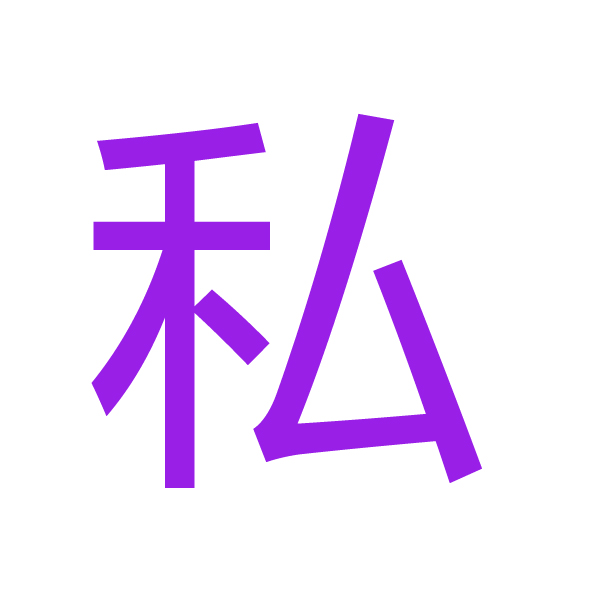
1. Meaning and Usage
The core meaning of the kanji 私 is "private," "I," "me," or "my." It is the primary and most common first-person pronoun for adults in Japanese, used by both men and women in formal and standard situations.
Common Readings and Words:
わたし (watashi): The standard, polite first-person pronoun ("I", "me").
わたくし (watakushi): A very formal version of "I", used in official speeches and business settings.
し (shi): The Sino-Japanese reading used in compound words, almost always meaning "private."
私立 (shiritsu): Private (institution). e.g., 私立大学 (shiritsu daigaku) - private university. (私-private + 立-stand)
個人 (kobetsu): Personal, individual. (個-individual + 別-separate)
公私 (kōshi): Public and private. (公-public + 私-private)
2. Correct Stroke Order
Writing 私 correctly requires attention to its two main components. The correct stroke order ensures balance and legibility.
Total Strokes: 7
Step-by-Step Breakdown:
Left Component: 禾 (Nogi-hen - Grain)
Stroke 1: Short left-falling stroke (撇).
Stroke 2: Short horizontal stroke (横).
Stroke 3: Short vertical stroke (竖) in the center.
Stroke 4: Left-falling stroke (撇) from the center.
Stroke 5: Right-dot stroke (捺). Note: The "grain" radical is written completely before moving to the right side.
Right Component: ム (mu)
Stroke 6: Short left-falling stroke (撇), starting from the top.
Stroke 7: A complex stroke that is a horizontal折 (oritsu). It starts with a short horizontal, then turns into a downward curve, and finishes with a hook to the left. This is the most characteristic stroke of this kanji.
Key Stroke Order Rules Applied:
Left to Right: Complete the left radical 禾 before starting the right component ム.
Top to Bottom: This rule governs the order of strokes within the 禾 radical.
3. Historical Origins and Etymology (The "Story" Behind the Kanji)
The history of 私 is fascinating because its original meaning was completely different from its modern use. It is classified as a 形声文字 (keisei moji) or phonetic-ideographic compound.
Let's break down its components:
Semantic Component (Original Meaning): 禾 (Nogi - Grain)
This radical means "grain" or "rice plant." Its presence indicates the character's original meaning was related to agriculture.
Phonetic Component (Sound): ム (mu)
This component provided the ancient Chinese pronunciation. However, its shape is also key to the story.
The Evolution of Meaning:
The original meaning of 私 was not "I" or "private," but "unfair," "selfish," "partial," or "to bend."
The Agricultural Link: One theory suggests that 私 represented a twisted or irregularly shaped grain (禾) that was misshapen and not suitable for public tax contribution. Such grains were kept for private use. This created a dichotomy: the straight, good grains were for the public (公 kō), and the crooked, bad grains were for the private (私 shi) individual.
The Shape Link: The component ム is thought to resemble a tool that wraps or bends something. Combined with "grain," it may have implied something "bent" or "not straight," metaphorically leading to "unfair" or "selfish."
Over time, this negative connotation of "selfish" softened and narrowed. The meaning shifted from "selfish" to simply pertaining to the self, and eventually became the standard, neutral word for "I" and "private."
The Chinese character for "public," 公, reinforces this theory. It is composed of 八 (to divide) and ム (the same component as in 私). The original idea was that "public" is what is divided fairly among everyone, in contrast to what is kept for oneself.
4. Example Sentences
Here are some example sentences showing the different uses of 私.
As a Pronoun (I/Me):
Romanji: Watashi wa gakusei desu.
English: I am a student.
私は学生です。
As a Pronoun (My - with の):
Romanji: Kore wa watashi no hon desu.
English: This is my book.
これは私の本です。
In a Compound Word (Private):
Romanji: Shiritsu no gakkō ni kayotte imasu.
English: I attend a private school.
私立の学校に通っています。
Summary
Meaning: I, me, my; private.
Writing: 7 strokes. Write the left "grain" radical 禾 first, then the right component ム.
Origin: A phonetic-ideographic compound. Its original meaning was "unfair" or "selfish," likely originating from the concept of "crooked grain kept for private use," which stood in opposition to "public." This meaning later softened to become the standard word for "I" and "private."