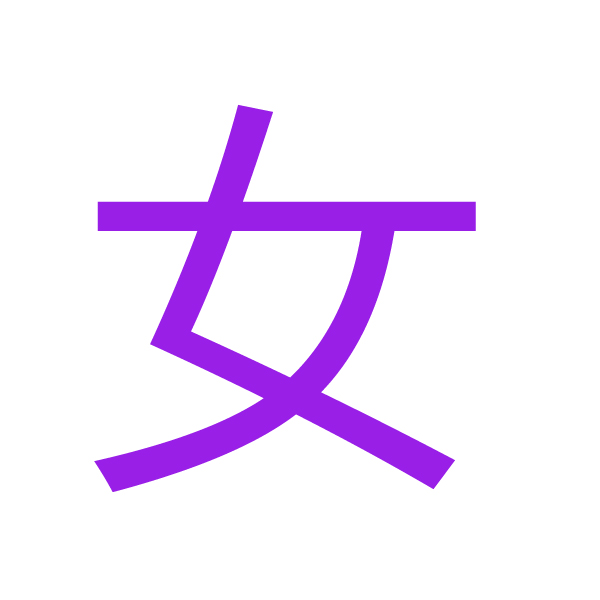
The Kanji: 女 (Onna/Jō/Nyo) - The "Woman" Kanji
The kanji "女" is one of the most fundamental characters in Japanese, directly representing "woman," "female," or "daughter." Its elegant and distinctive form has a rich and debated history.
1. Meaning and Usage
Core Meanings: Woman; female; daughter.
Readings:
Kun'yomi (Japanese reading): おんな (onna), め (me)
On'yomi (Chinese reading): ジョウ (jō), ニョ (nyo), ニョウ (nyō)
Common Words and Compounds:
女 (おんな / onna) - Woman
女の人 (おんなのひと / onna no hito) - A woman (person)
女の子 (おんなのこ / onna no ko) - Girl
男女 (だんじょ / danjo) - Men and women
少女 (しょうじょ / shōjo) - Young girl; maiden
長女 (ちょうじょ / chōjo) - Eldest daughter
2. Writing and Stroke Order: An Elegant and Fluid Form
The correct kanji writing for "女" is unique. Unlike many angular kanji, it is defined by its graceful, curved strokes. Mastering its stroke order is essential for achieving its proper, balanced form.
Stroke Order:
Stroke 1: A left-falling stroke that curves slightly. This is the first part of the character's "posture."
Stroke 2: A short horizontal stroke that does not touch the first stroke. This is often interpreted as the arms or a sash.
Stroke 3: A single, fluid stroke that starts from the top-right, sweeps down to form the right side, crosses over the first stroke, and ends with a long horizontal line that serves as the "base" of the character. This is the most characteristic stroke of "女."
Significance of Correct Kanji Writing:
Balance and Posture: The character should look stable and elegant. The final long horizontal stroke is crucial as it acts as a base, preventing the character from looking like it's falling over. The three strokes must intersect and balance each other perfectly.
Fluid Motion: The third stroke is meant to be a continuous, sweeping motion. Practicing this fluidity is key to writing "女" correctly and beautifully.
Radical Recognition: As the "woman" radical (おんなへん, onnahen), it appears on the left side of many other kanji, where it becomes narrower (姉 - older sister, 妹 - younger sister, 妻 - wife). Mastering the standalone form is the first step.
3. Historical Origin and Evolution
The history of "女" is a subject of discussion, but it universally points towards a pictogram of a female figure.
Oracle Bone Script (甲骨文字):
The earliest form is widely believed to be a pictogram of a woman kneeling or sitting cross-legged, viewed from the side. The character elegantly depicted a figure with a head, a torso, and two arms crossed respectfully in front—a common sitting posture in ancient times. This interpretation emphasizes grace and posture.
Bronze Script (金文) & Seal Script (篆書):
The form became more stylized and abstract. The curved lines representing the body and arms were emphasized, making the character more symbolic than pictorial. The distinctive features of the kneeling figure with crossed arms were still discernible.
Modern Form (楷書):
The modern "女" is a complete stylization of the ancient pictogram. The original depiction of a kneeling figure has been transformed into three abstract strokes. However, the memory of the form is preserved: the first stroke suggests the head and back, the second suggests the arms, and the sweeping third stroke suggests the body and the seated posture.
Cultural and Conceptual Connection:
The character "女" is at the heart of many words related to family, beauty, and nature.
安 (やす - cheap/peaceful): A woman (女) under a roof (宀). This character suggests the ancient concept that a home is peaceful and complete with a woman in it.
好 (す - to like): A woman (女) and a child (子). This character conveys the idea of affection and what is good.
娘 (むすめ - daughter): Combines the "woman" radical with a component indicating a "good" or "young" woman.
While its origin may reflect specific historical social postures, the character today is a neutral and essential symbol for the female gender.
Summary
The kanji "女" is a character of grace and historical depth. It began as a stylized drawing of a kneeling female figure and evolved into the elegant, abstract symbol used today. Mastering its unique, flowing stroke order is a fundamental and rewarding challenge in Japanese kanji writing. When you learn how to write kanji like "女," you are not just learning a word for "woman"; you are learning a radical that forms the basis of countless characters related to family and society, and you are connecting with a visual representation of femininity that is thousands of years old.