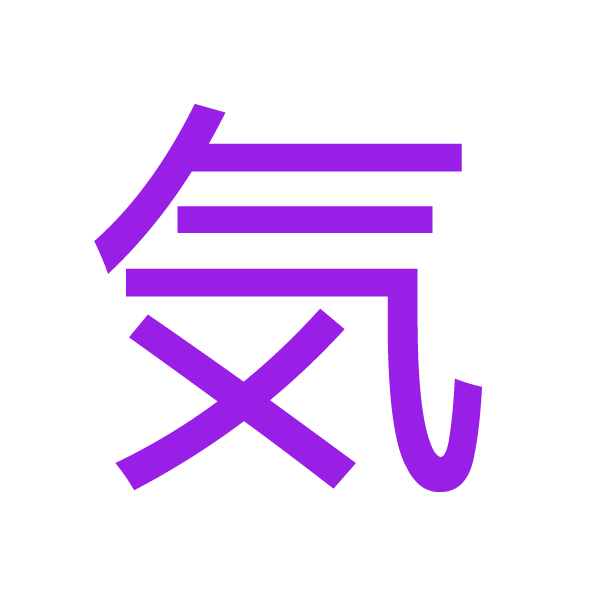
The Kanji: 気 (Ki/Ke) - The "Spirit" and "Energy" Kanji
The kanji "気" is one of the most important and frequently used characters in Japanese. It represents an invisible but pervasive force, encompassing meanings from "spirit" and "energy" to "air" and "atmosphere." It is central to both everyday language and philosophical thought.
1. Meaning and Usage
Core Meanings: Spirit; mind; energy; air; atmosphere; mood; attention.
Readings:
Kun'yomi (Japanese reading): き (ki)
On'yomi (Chinese reading): ケ (ke), キ (ki)
Common Words and Compounds:
元気 (げんき / genki) - Healthy; energetic (Original spirit)
天気 (てんき / tenki) - Weather (Heaven's energy/air)
人気 (にんき / ninki) - Popularity (Human feeling/atmosphere)
電気 (でんき / denki) - Electricity (Lightning energy)
気をつけて (きをつけて / ki o tsukete) - Be careful (Pay attention)
2. Writing and Stroke Order: A Dynamic Flow
The correct kanji writing for "気" is unique and must be executed with a sense of flow. Its modern form is a simplification of a more complex character.
Stroke Order:
Stroke 1: A short left-falling stroke.
Stroke 2: A long horizontal stroke from left to right. This is the main "base" of the character.
Stroke 3: A single, fluid stroke that is the core of the character:
Start with a short horizontal line at the top-right.
Turn sharply downward into a long, curved vertical stroke.
Finish with a hook at the bottom.
Stroke 4: Two dots (or a small cross) inside the curved stroke, written from top to bottom.
Significance of Correct Kanji Writing:
Balance and Flow: The long, curved third stroke gives the character its dynamic energy. The two internal dots must be centered and balanced within the curved space.
Proportions: The long horizontal stroke (2) provides a stable base, while the curved stroke (3) gives the character its height and distinctive shape.
Common Mistake: A common error is to write the internal dots first or to make the curved stroke too straight. The correct order and curvature are essential for the character's aesthetic.
3. Historical Origin and Evolution
The history of "気" is a story of profound philosophical abstraction and later, practical simplification.
Original Character (氣):
The traditional form was "氣". This character was a powerful ideogram:
The top component (气) is a pictogram of "steam" or "vapor" rising from the ground. This itself is a character meaning "air" or "gas."
The bottom component (米) means "rice."
The Conceptual Origin:
The original meaning of "氣" was "the steam rising from cooking rice." This was a genius conceptualization of an invisible, life-sustaining energy. Just as steam is the vital essence of rice transforming into nourishment, "気" (Ki) came to represent the vital energy or life force that animates all living things. This is the foundation of the concept of "Qi" in Chinese philosophy and "Ki" in Japanese culture.
Modern Simplification (気):
The modern Japanese form "気" is a simplification (新字体, shinjitai). The bottom "rice" (米) component was replaced with an "X" shape, which was later stylized into the two dots or a small cross we see today. This simplified form is easier to write but retains the core meaning of the original—the rising, vaporous energy.
Philosophical and Cultural Connection:
"気" is arguably the most philosophical kanji in common use. It is the foundation of many core Japanese concepts:
In Martial Arts (Aikido, Kendo): Ki is the internal energy that practitioners seek to harness and unify with their technique.
In Medicine and Health: 元気 (Genki) refers to one's fundamental vitality and health.
In Social Interaction: Being able to read the 空気 (Kūki - "air") means to understand the unspoken mood of a situation. Having やる気 (Yaruki) means having the "will" or "motivation" to do something.
Summary
The kanji "気" is a character of incredible depth and abstraction. It began as a concrete image of life-sustaining steam and evolved into the universal symbol for the invisible energies that govern the universe, the mind, and human interaction—from the air we breathe to the mood in a room. Mastering its flowing stroke order is a crucial step in Japanese kanji writing. When you learn how to write kanji like "気," you are not just learning a character; you are learning a key to understanding a fundamental concept that permeates Japanese language, culture, and philosophy. It gives form to the formless.