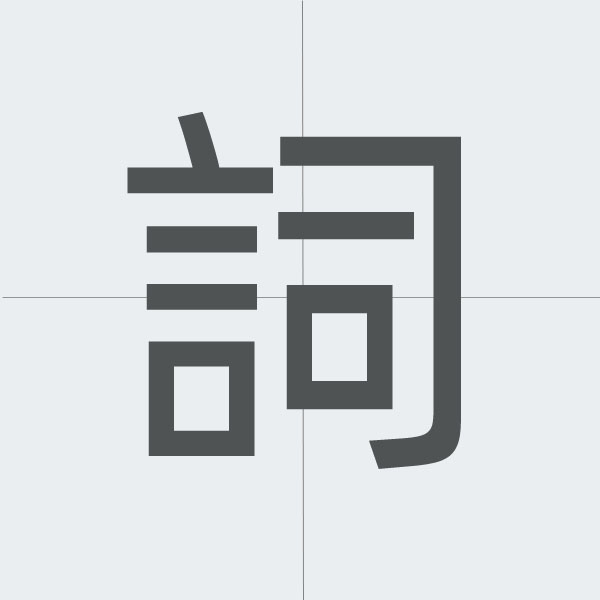
The Kanji: 詞 (Shi / Kotoba)
The kanji 詞 (read as shi) primarily means "word," "poetry," or "part of speech." It belongs to the family of characters related to language, specifically denoting words used in a formal or literary context, such as in poetry or grammar. It is composed of the radical 言 (speech/language) and the component 司 (to direct, to manage), suggesting the idea of "directed speech" or formally organized words.
Common Words & Example Sentences
1. 歌詞 (kashi)
Meaning: Song lyrics.
Example Sentence: この曲の歌詞はとても感動的です。
(Kono kyoku no kashi wa totemo kandōteki desu.)
"The lyrics of this song are very moving."
2. 形容詞 (keiyōshi)
Meaning: Adjective (in grammar).
Example Sentence: 「美しい」は形容詞です。
("Utsukushii" wa keiyōshi desu.)
"'Utsukushii' (beautiful) is an adjective."
3. 詞典 (jiten)
Meaning: Dictionary (a less common reading for 辞典).
Example Sentence: 難しい言葉は詞典で調べます。
(Muzukashii kotoba wa jiten de shirabemasu.)
"I look up difficult words in a dictionary."
4. 詞華集 (shikashū)
Meaning: Anthology of poems; literary collection.
Example Sentence: 彼女は詞華集を出版した。
(Kanojo wa shikashū o shuppan shita.)
"She published a poetry anthology."
In summary, 詞 is a formal kanji representing words in structured contexts, from the lyrics of a song (歌詞) and grammatical terms (形容詞) to literary collections (詞華集). It reflects the organized and artistic use of language.