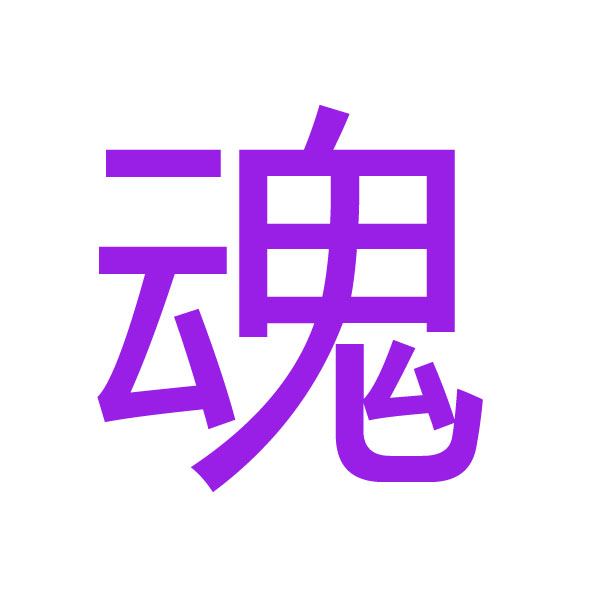
1. Kanji Breakdown: 魂
This kanji is a powerful and profound character.
Meaning: Soul, spirit, ghost, heart, mind. It refers to the non-physical essence of a living being, the core of one's emotions and will, much stronger than just "spirit" (気 / 精霊).
Reading:
Onyomi (Sino-Japanese reading): コン (kon)
Kunyomi (Native Japanese reading): たましい (tamashii)
2. Stroke Order and Writing
Learning the correct stroke order is crucial for balanced and beautiful kanji. "魂" is a compound kanji made of two parts.
Left Side: 云 (meaning "to say," but here it's a phonetic component)
Right Side: 鬼 (meaning "ogre," "demon," or "ghost")
Here is the stroke order diagram and explanation:
Total Strokes: 14
Start with the left radical "云":
Then, write the right radical "鬼":
Key Writing Tips:
Write from top to bottom, left to right.
Pay attention to the balance. The "鬼" part is larger and dominates the right side.
The final stroke of "鬼" is the hook (はね) at the bottom.
3. Vocabulary and Example Sentences
Here are some common words using "魂" and how to use them in sentences.
Vocabulary
魂 (たましい, tamashii)
Meaning: Soul, spirit.
Example: 彼は優しい魂の持ち主だ。
Romaji: Kare wa yasashii tamashii no mochinushi da.
English: He is a person with a kind soul.
心魂 (しんこん, shinkon)
Meaning: One's whole heart and soul; utmost effort.
Example: 心魂を込めて作品を作った。
Romaji: Shinkon o komete sakuhin o tsukutta.
English: I created the work with all my heart and soul.
魂胆 (こんたん, kontan)
Meaning: Ulterior motive, secret intention, plot. (This word often has a negative connotation).
Example: 彼の言葉には何か魂胆がありそうだ。
Romaji: Kare no kotoba ni wa nanika kontan ga arisō da.
English: It seems there's some ulterior motive behind his words.
魂魄 (こんぱく, konpaku)
Meaning: Soul and spirit (a more classical or literary term for the soul).
Example: その儀式は魂魄を鎮めるためのものだ。
Romaji: Sono gishiki wa konpaku o shizumeru tame no mono da.
English: That ritual is for pacifying the soul.
魂の叫び (たましいのさけび, tamashii no sakebi)
Meaning: A cry from the soul; a heartrending cry.
Example: 彼女の歌はまさに魂の叫びだった。
Romaji: Kanojo no uta wa masani tamashii no sakebi datta.
English: Her song was truly a cry from the soul.
Summary
Kanji: 魂
Core Meaning: Soul, Spirit (the deepest essence of a person).
Readings: On'yomi コン (kon), Kun'yomi たましい (tamashii)
Stroke Order: 14 strokes. Remember it's composed of 云 (left) and 鬼 (right). Practice writing it step-by-step to master its form.
By understanding its components (a "ghost" that "speaks" to your inner self), it becomes easier to remember its deep meaning. Keep practicing the stroke order, and try using it in vocabulary to solidify your understanding