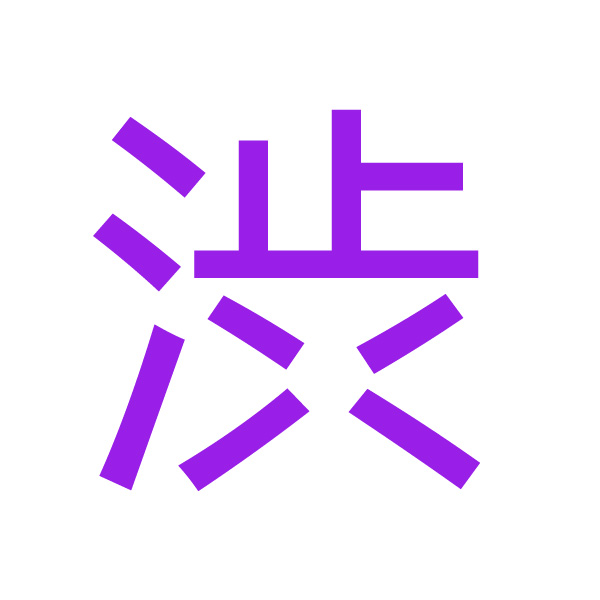
1. Meaning and Usage
The core meaning of the kanji 渋 is "astringent," "bitter," "harsh," "to hesitate," or "to be stunted." It describes a rough, puckering sensation, a reluctance to proceed, or something that is not smooth or flowing.
Common Readings and Words:
じゅう (jū): The Sino-Japanese reading, used in some compound words.
渋滞 (jūtai): Traffic jam, congestion. (渋-stagnate + 滞-stagnate)
しぶ (shibu): The native Japanese reading.
渋い (shibui): An adjective that is a key aesthetic concept in Japan. It can mean "astringent" (like a persimmon), "sober," "subdued," "rustic," "elegantly simple," and by extension, "cool in a mature, understated way."
渋る (shiburu): To hesitate, to be reluctant.
This kanji is most famous globally as part of the name for Tokyo's famous shopping and entertainment district, 渋谷 (Shibuya).
2. Correct Stroke Order
Writing 渋 correctly is essential for balance. The kanji is composed of the left radical 氵(sanzui - water) and the right component 止 (tomeru).
Total Strokes: 11
Step-by-Step Breakdown:
Left Radical: 氵 (Sanzui - Water)
Stroke 1: The upper dot (点).
Stroke 2: The middle dot (点).
Stroke 3: The lower dot, drawn as a rising stroke (提). Note: The "water" radical is written completely before moving to the right side.
Right Component:
Stroke 4: The short vertical stroke (竖) at the top.
Stroke 5: The short horizontal stroke (横) below it.
Stroke 6: The second short horizontal stroke (横).
Stroke 7: The long vertical stroke (竖) through the center.
Stroke 8: The short horizontal stroke (横) at the bottom.
Stroke 9: The second short horizontal stroke (横) at the very bottom.
Key Stroke Order Rules Applied:
Left to Right: The entire left radical 氵 is written before the right component.
Top to Bottom: This rule governs the order within the right component.
3. Historical Origins and Etymology (The "Story" Behind the Kanji)
The history of 渋 is a clear example of an ideographic compound (会意文字 kaii moji), where the original meaning is logically derived from its parts.
Let's break down its two components:
氵 (Sanzui): This is the "water" radical. It represents liquid or flow.
止 (Tomeru): This character means "to stop," "to halt." Its pictograph is a footprint, symbolizing the act of coming to a standstill.
The Combined Meaning:
The character 渋 creates a perfectly intuitive concept:
"Water (氵) that has stopped (止) flowing."
This imagery is the key to all its modern meanings:
Astringent Taste: When your mouth feels "dry" or "puckered" after eating an unripe persimmon, it's as if the saliva in your mouth has "stopped flowing."
Reluctance/Hesitation: When a person is reluctant, their will or action "stops flowing" smoothly. They "hesitate" (渋る shiburu).
Traffic Jam: In a "traffic jam (渋滞 jūtai)", the flow of cars has "stopped."
The "Shibui" Aesthetic: This is a more abstract and refined evolution. Something that is shibui is not flashy; it is restrained, subtle, and mature. Its beauty is not immediately obvious—it doesn't "flow" out at you. You must pause and appreciate it, as if the initial impression has been "held back" to reveal a deeper quality.
4. Example Sentences
Here are some example sentences showing the different uses of 渋.
As a Place Name:
Romaji: Shibuya de tomodachi to machiawaseta.
English: I met up with my friend in Shibuya.
渋谷で友達と待ち合わせた。
As "Traffic Jam":
Romaji: Tsūkin tochū de jūtai ni makikomareta.
English: I got caught in a traffic jam on my way to work.
通勤途中で渋滞に巻き込まれた。
As the Aesthetic "Shibui":
Romaji: Kare no shibui sētā ga totemo suteki da.
English: His tasteful, understated sweater is very nice.
彼の渋いセーターがとても素敵だ。
As "To Hesitate":
Romaji: Kare wa okane o harau no o shibutta.
English: He hesitated to pay the money.
彼はお金を払うのを渋った。
Summary
Meaning: Astringent, bitter, to hesitate, harsh; also a key Japanese aesthetic (shibui) meaning subdued and elegant.
Writing: 11 strokes. Write the left "water" radical 氵 first, then the right component which incorporates 止 (to stop).
Origin: An ideographic compound. It combines 氵 (water) with 止 (to stop) to mean "water that has stopped flowing." This powerful image of stagnation or restriction is the source of all its meanings, from a physical sensation in the mouth, to hesitation, to traffic congestion, and even to a refined aesthetic of restrained beauty.