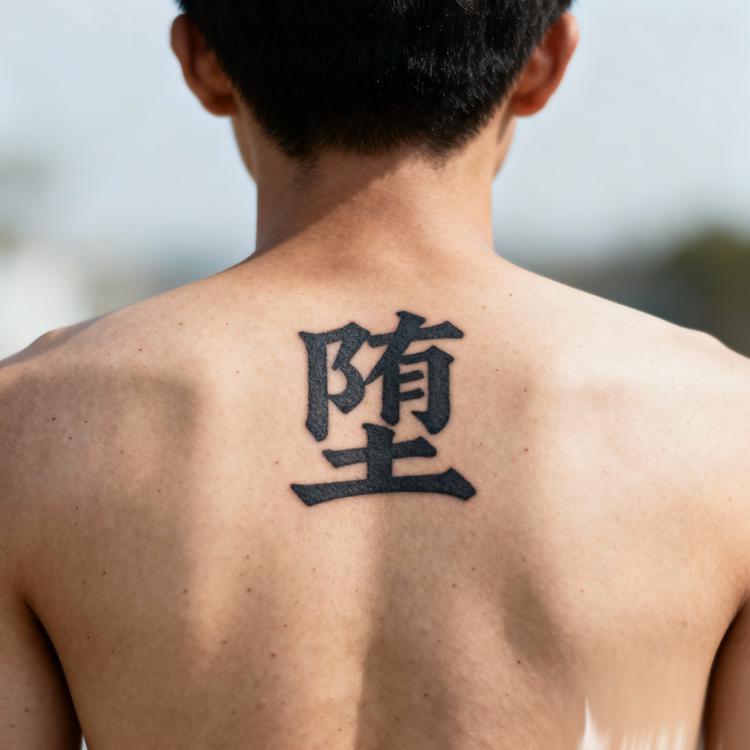
Kanji Analysis: 堕 (DA / ochiru)
Meaning:
The core meaning of the kanji 堕 is "to fall," "to degenerate," "to sink," or "to lapse." It carries a strong negative connotation, implying a fall from a higher state—be it moral, spiritual, or physical—into a lower, worse, or corrupted state.
Composition:
Radical: 土 (つち, tsuchi) - The "earth" or "ground" radical at the bottom. This visually reinforces the idea of falling down to the ground.
Phonetic Component: 隋 (DAI) - This component provides the sound ("da").
The character's structure vividly depicts a descent or a fall onto the earth.
Common Usages and Examples
This kanji is used in contexts of moral decline, failure, and falling.
Common Compound Words:
堕落 (daraku): Corruption, degradation, depravity, a moral fall.
堕胎 (datai): Abortion (a medically and legally formal term, but with heavy moral and ethical weight).
堕ちる (ochiru): The verb "to fall," "to degenerate," "to lapse into." (e.g., 眠りに堕ちる - nemuri ni ochiru - to fall into sleep).
堕天使 (datenshi): Fallen angel.
Example Sentences:
彼は快楽の生活に堕落した。
(Kare wa kairaku no seikatsu ni daraku shita.)
"He degenerated into a life of pleasure."あの天使は堕天使となった。
(Ano tenshi wa datenshi to natta.)
"That angel became a fallen angel."深い眠りに堕ちていった。
(Fukai nemuri ni ochite itta.)
"He sank into a deep sleep."
"堕" as a Tattoo: Meanings and Cautions
As a tattoo, "堕" is an extremely high-risk and generally inadvisable choice. Its primary meaning is overwhelmingly negative, though it can be reinterpreted in specific, niche contexts.
Potential Personal Meanings (The Reinterpreted Intent):
A Symbol of Rebellion or Non-Conformity: Drawing from 堕天使 (fallen angel), it could be used to symbolize rebellion against authority, conventional morality, or societal norms. It can represent an embrace of one's own "fallen" or "imperfect" nature as a form of authenticity.
Acceptance of a "Fall" and Resilience: For someone who has "hit rock bottom" (e.g., through addiction, failure, or trauma) and has since rebuilt their life, it could symbolize that descent and the strength it took to survive it. It's a stark acknowledgment of a dark past.
Aesthetic of the "Fallen Angel": The "fallen angel" archetype can be seen as tragic, beautiful, and powerful. Someone might choose it purely for this darkly romantic aesthetic.
Strong Cautions and Negative Connotations (Extremely Important!):
Overwhelmingly Negative Primary Meaning: This is the biggest risk. To any Japanese person, this character means "CORRUPTION," "DEGENERATION," and "A MORAL FALL." It is a word associated with sin, depravity, and failure. A tattoo would be perceived as you identifying with deeply negative traits.
Association with a Highly Charged Topic: The word 堕胎 (datai) means "abortion." This is an extremely sensitive and politically/ethically charged topic. The tattoo could be misinterpreted as a statement on this issue, which is likely not the wearer's intent.
Invitation of Negative Judgment and Energy: The character carries a heavy, pessimistic energy. Permanently wearing it could be seen as inviting negativity or representing a fundamentally cynical worldview.
Social Misunderstanding: This tattoo would be seen as disturbing, antisocial, or edgy in a negative way. It does not convey a positive virtue and would likely cause concern or aversion.
Final Verdict and Recommendation
"堕" is generally NOT RECOMMENDED for a tattoo.
The risk of severe misunderstanding, social offense, and negative perception is far too high. The positive reinterpretations are niche and are vastly overshadowed by the character's powerful and primary associations with corruption and sin.
If you are drawn to the concepts of "rebellion," "transformation from darkness," or the "fallen angel" aesthetic, here are more nuanced alternatives:
For Rebellion, use 反逆 (hangyaku).
For Transformation or Change, use 変革 (henkaku).
For a Dark or Mysterious Aesthetic, consider 闇 (yami - darkness) or 魔 (ma - demon, evil spirit), though these also carry significant risk and should be chosen with extreme caution.
For the concept of "rising from the fall," a kanji like 昇 (shō - to rise) or 復活 (fukkatsu - resurrection) would be a more positive and powerful symbol of overcoming adversity.
In summary:
While "堕" can conceptually represent rebellion or a acknowledgment of a difficult past, as a permanent tattoo, it is an exceptionally poor and ill-advised choice. Its inherent meaning is too negative and its potential for misinterpretation is too great. Choosing an alternative character is a much safer and more effective way to express a complex personal narrative.