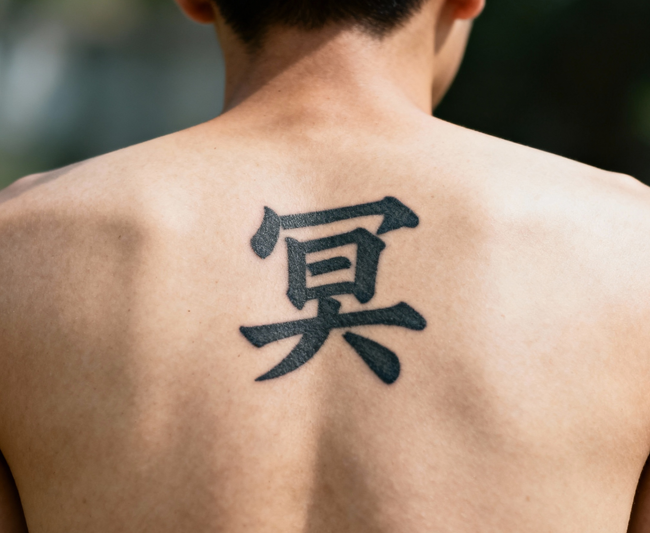
 1. Direct Meaning and Breakdown of the Kanji "冥" (Mei)
The kanji 冥 is a profound and ancient character with meanings connected to the hidden, the deep, and the afterlife.
Core Meaning: Dark, obscure, deep; the underworld, the world of the dead; profound (as in thought).
Keyword: The deep, hidden realm beyond ordinary perception.
Pronunciation:
メイ (Mei): The on'yomi (Sino-Japanese reading).
Etymological Breakdown:
The character 冥 is a highly evocative picto-ideogram. Its structure is composed of:
冖 (Bekkou - "covering" radical): This represents a cover or a veil.
日 (Hi - "sun"): This is the sun.
六 (Roku - "six"): In this context, it is not the number, but an old representation of two hands.
Combining these, 冥 creates the powerful image of "two hands covering the sun, plunging the world into darkness." This represents the world of the dead, the deep unknown, or a state of profound obscurity and mystery.
Common Usage in Japanese:
This kanji is used in words with deep philosophical, religious, or poetic connotations:
冥土 (Meido): The world of the dead, the underworld, the afterlife.
冥福 (Meifuku): Posthumous happiness, eternal rest. This is a common phrase used to express condolences, as in "ご冥福をお祈りします" (Go-meifuku o o-inori shimasu - "I pray for the repose of their soul").
冥王星 (Meiōsei): Pluto, the dwarf planet (literally, "Underworld King Star").
冥利 (Myōri): Spiritual benefit, blessedness.
冥想 (Meisō): Deep thought, meditation (a less common alternative for 瞑想).
2. "冥" as a Tattoo: Meanings and Interpretations
As a tattoo, "冥" is a deeply philosophical, somber, and powerful choice. It is not a lighthearted symbol but one that confronts the fundamental mysteries of existence.
Positive and Profound Meanings:
Acceptance of Mortality and The Cycle of Life (Memento Mori): This is the core interpretation. The tattoo can be a stark and permanent memento mori—a reminder of one's own mortality and the inevitability of death. It symbolizes an acceptance and understanding of the life-death cycle, leading to a more meaningful and present life.
The Pursuit of Profound Depth and Insight: "冥" can represent the journey into the depths of one's own mind, soul, or a particular field of study. It symbolizes a commitment to seeking truths that are not surface-level, but hidden in the "darkness" or obscurity. It is the realm of the philosopher, the mystic, and the deep thinker.
A Connection to the Ancestral or Spiritual World: The tattoo can be a tribute to deceased loved ones, symbolizing a belief in an afterlife or a connection to the world of the ancestors. It can be a private memorial and an acknowledgment of a realm beyond our own.
Transformation Through The "Dark Night of The Soul": It can represent a period of immense personal difficulty, a "dark night of the soul," from which one emerged transformed. The darkness of "冥" is not an end, but a necessary phase of incubation and metamorphosis before a new understanding or a rebirth.
Potential Pitfalls and Warnings:
Overwhelmingly Somber and Morbid Connotation: This is the biggest risk. To many, including Japanese people, this character's primary association is with death, the underworld, and funerary rites (ご冥福). It can be perceived as deeply pessimistic, morbid, or unsettling.
Cultural and Social Misunderstanding: Using a symbol so closely tied to mourning and the afterlife as a personal tattoo could be seen as strange, disrespectful, or in poor taste.
Potential for Negative Energy: Some may feel that wearing a symbol of the "underworld" invites negative energy or is a bad omen.
3. Design and Styling Suggestions
If this symbol's profound meaning resonates with you, the design should reflect its solemn and powerful nature.
Calligraphy Style: A heavy, bold, or stark calligraphy style would match the character's weighty meaning. Alternatively, a very ethereal, light style could represent its connection to the spiritual realm.
Incorporating Imagery: Imagery can help guide the interpretation.
A stylized ouroboros (snake eating its tail) or phoenix could be incorporated to emphasize the cycle of death and rebirth.
A solar eclipse, directly referencing the character's etymology of "covering the sun."
Cosmic imagery like galaxies or nebulae, representing the vast, dark unknown of space.
Minimalist Style: A simple, clean, and bold black tattoo can be very striking, representing an unadorned acceptance of the character's core meaning.
Placement: A private placement (ribcage, upper back) is often more appropriate for such a personal and intense symbol.
Summary
| Aspect | Explanation |
|---|---|
| Kanji | 冥 |
| Pronunciation | Mei |
| Core Meaning | The dark underworld; deep, obscure, profound. |
| Tattoo Meaning | Memento Mori, Profound Insight, Spiritual Connection, Transformation through Darkness. |
| Suitability | A niche, intellectual, and high-risk choice. It is only for those who have a deep, philosophical relationship with themes of mortality, the unknown, and inner depth, and who are comfortable with its somber and potentially morbid connotations. |
Final Advice:
冥 is a tattoo for the philosopher and the contemplative. It is for those who are not afraid to stare into the void and contemplate the deepest mysteries of existence. It is a symbol of ultimate acceptance. However, it is crucial to understand that its primary cultural association is with death and the afterlife. This is not a symbol to be chosen lightly for its aesthetic. If you are drawn to the concept of "depth" or "meditation" without the heavy funerary connotation, the kanji 深 (fukai - "deep") or 瞑 (mei - "to close eyes," "to meditate") are safer and more direct alternatives. "冥" is a commitment to a specific, profound, and challenging worldview.