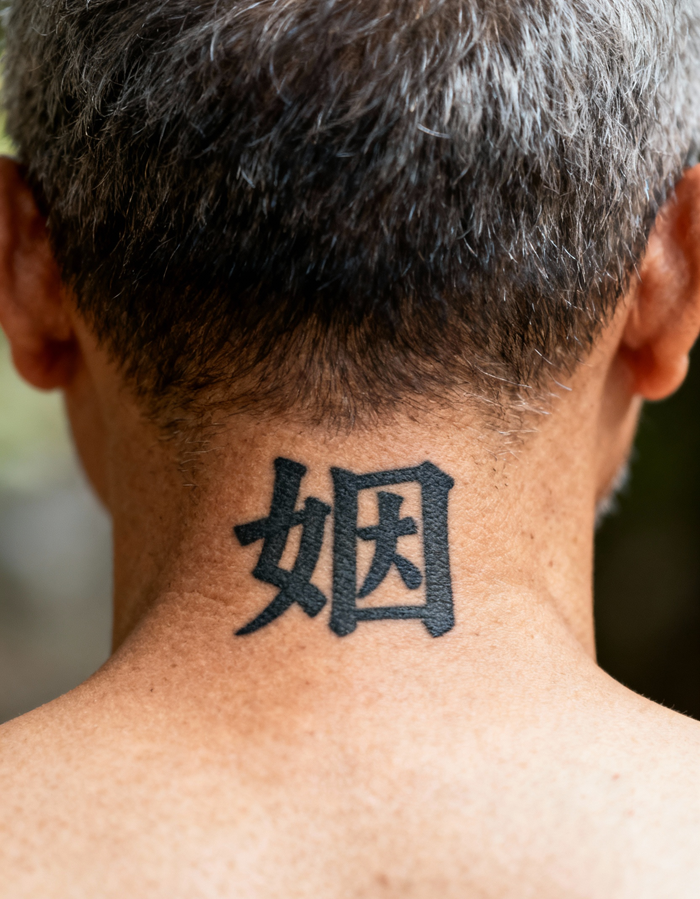
 1. Direct Meaning and Breakdown of the Kanji "姻" (In)
The kanji 姻 carries a specific and socially significant meaning.
Core Meaning: Marriage, matrimonial tie.
Keyword: A bond created through marriage.
Pronunciation:
イン (In): The on'yomi (Sino-Japanese reading).
Etymological Breakdown:
The character 姻 is a phono-semantic compound, composed of two parts:
女 (Onna - "woman"): This radical places the character's meaning in the realm of relationships and femininity.
因 (In - "cause," "reason," "to depend on"): This component provides the pronunciation and contributes a crucial part of the meaning.
Combining these, 姻 creates the conceptual meaning of "a woman forming a bond that becomes the foundation (cause/reason) for a new family." It represents the idea that marriage is a fundamental relationship upon which family lines and social structures are built.
Common Usage in Japanese:
This kanji is almost exclusively used in words related to marriage and family ties:
婚姻 (Kon'in): Marriage, matrimony. This is the most common and formal word for marriage.
姻族 (Inzoku): Relatives by marriage, in-laws.
姻戚 (Inseki): Affinal kin (relatives through marriage, not by blood).
2. "姻" as a Tattoo: Meanings and Interpretations
As a tattoo, "姻" is a direct, formal, and deeply personal choice. It is a clear and unambiguous symbol of the bond of marriage.
Positive and Profound Meanings:
A Celebration of Marriage and Commitment: This is the most direct and powerful interpretation. The tattoo can serve as a permanent symbol of one's own marriage or engagement. It is a declaration of the marital bond, representing love, commitment, partnership, and the creation of a new family unit.
A Tribute to a Spouse: It can be a name tattoo for a spouse, or simply a symbol representing them. It says, "This person is my '姻'—my reason and foundation for family."
Acceptance into a New Family: The tattoo can symbolize the joy and commitment of becoming part of a new family through marriage. It can represent the bond with in-laws and the acceptance of new relatives.
The Interconnectedness of Fate: Drawing from the "因" component meaning "cause," it can represent the belief that marriage is a fated connection, the "cause" that profoundly alters the course of one's life.
Potential Pitfalls and Considerations:
Extremely Specific Meaning: The meaning is very narrow. It refers specifically to the institution of marriage. It would be an unusual choice for someone who is not married or not directly celebrating a marital relationship.
Formal and Somewhat Impersonal Connotation: As part of the formal word "婚姻," the character itself can feel a bit bureaucratic or legalistic. The emotional weight must be supplied by the wearer's personal story.
Potential for Confusion: If worn by a single person, it could lead to confusion or assumptions about their marital status that may not be accurate.
3. Design and Styling Suggestions
The design for an "姻" tattoo can be enhanced to emphasize its meaning of union.
Calligraphy Style: A balanced, harmonious, and elegant script would be fitting. A style that connects the strokes can visually represent the "tying of the knot."
Incorporating Imagery: To make the symbol more personal and less formal, consider these elements:
Two interlocking rings (wedding bands) integrated with the character.
The character placed inside a heart or a stylized family crest.
Combining it with the name of one's spouse (in Roman letters or another kanji).
A red ink accent, as red is a traditional color for marriage and celebration in Japan.
Minimalist Style: A simple, clean design can be powerful in its straightforwardness, representing the clear and solid commitment of marriage.
Placement: Common and meaningful placements would be the ring finger (as a ring tattoo), the forearm, or over the heart.
Summary
| Aspect | Explanation |
|---|---|
| Kanji | 姻 |
| Pronunciation | In |
| Core Meaning | Marriage, matrimonial tie. |
| Tattoo Meaning | Marital Commitment, Celebration of Partnership, Family Union, Fated Love. |
| Suitability | A direct and meaningful choice, primarily for individuals who are married or engaged and wish to celebrate that specific bond in a permanent way. |
Final Advice:
姻 is a tattoo for a spouse. It is a clear, formal, and respectful symbol of the marital bond. If you are looking for a tattoo to celebrate your marriage in a way that is deeply rooted in Japanese language and culture, this is a precise and meaningful kanji.
However, if you are seeking a more general symbol for "love" or "relationship," you might consider:
愛 (Ai): Love.
絆 (Kizuna): Bond, connection (broader than just marriage).
結 (Musubu): To tie, to bind (can represent any deep connection).
Choosing "姻" is a specific declaration of a marital commitment. It is a beautiful and powerful choice for that specific purpose, but its meaning is not easily transferable to other types of relationships.